3.8 Exercise 1c
Exercise 1c
For $\dot{x}=r+x-\ln\left(1+x\right)$:
- i) Sketch the different vector field types that appear when you vary $r$. We’re actually going to do this first the hard way, then the easier way.
Looking at the phase portrait for different values of $r$ we get the following.
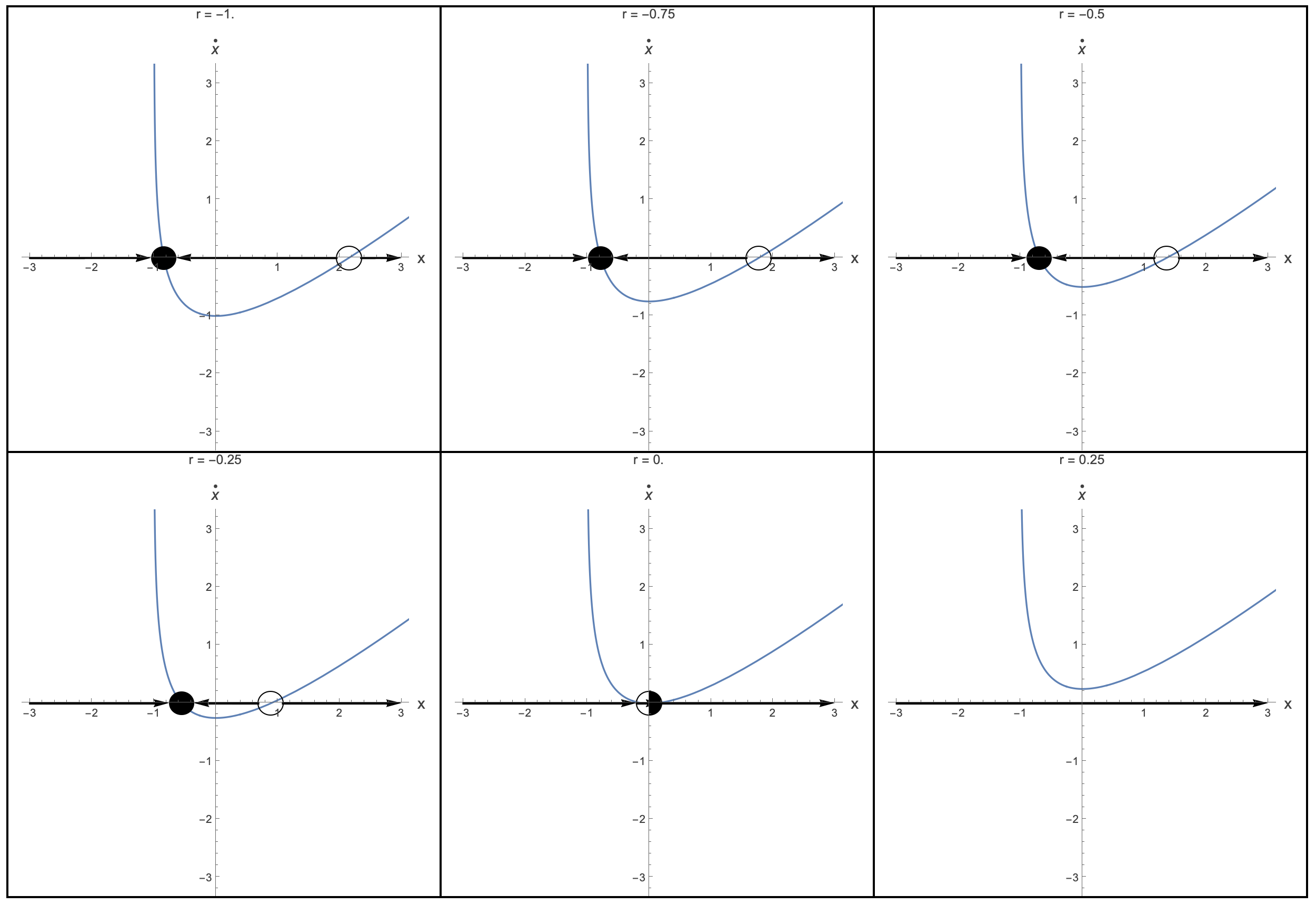
Now taking the arrows and fixed points alone and plotting them as a vector field:
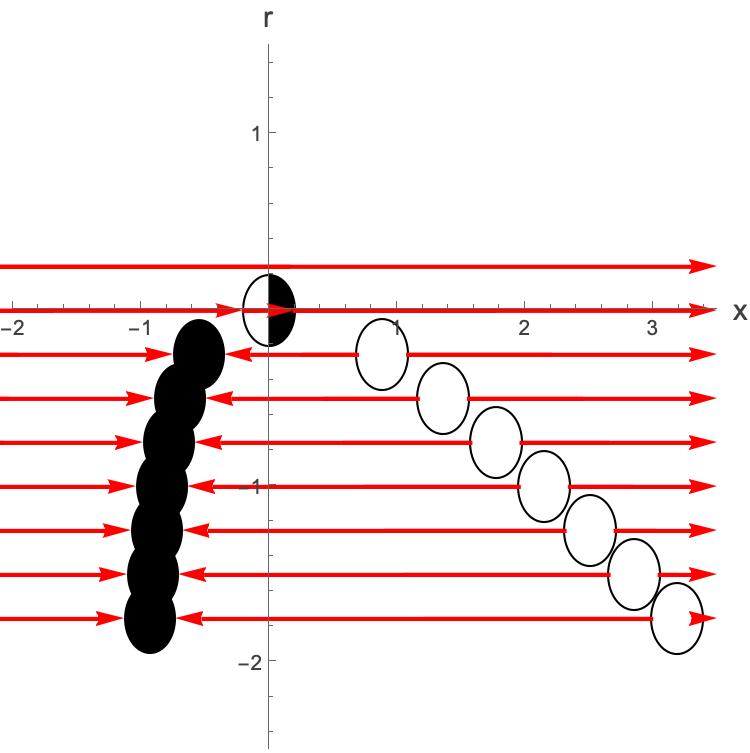
We get the bifurcation diagram by rotating this whole plot above:
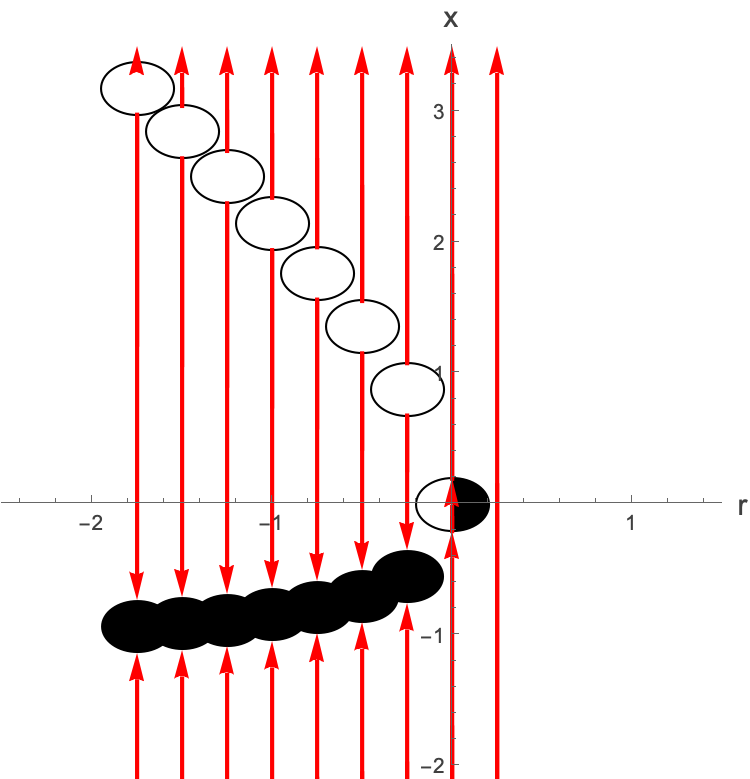
We can actually find these fixed points and thus the bifurcation diagram more simply. We need to solve $\dot{x}=r+x-\text{ ln }\left(1+x\right)=0. $We can only do this numerically though.
We can plot these fixed points and this gives us
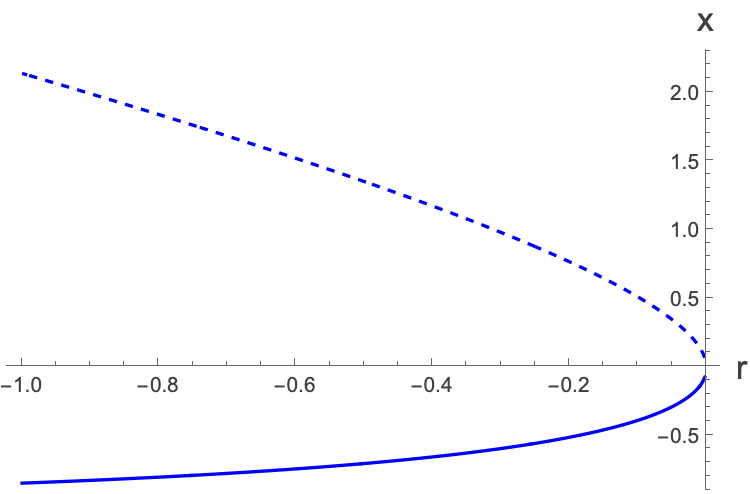
The critical point is when the there is only a single solution. This occurs when r=0, x=0:
Critical point at $r = 0$, and this occurs at: $x=0$:
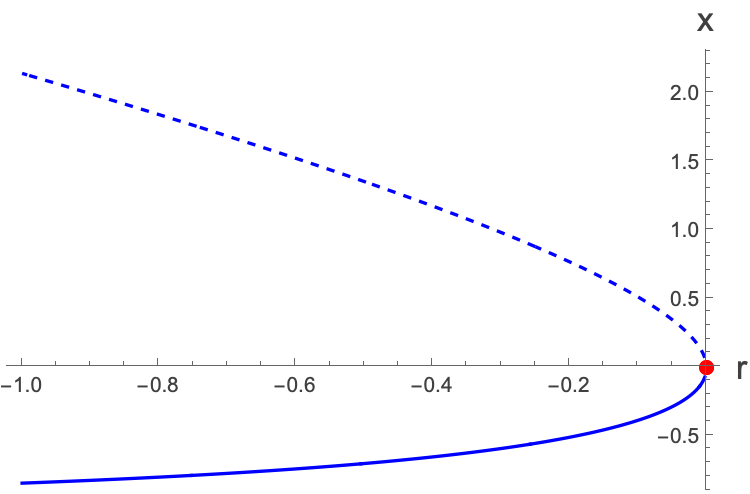
To get the equation about the critical point into normal form we can simply expand the right hand side of the equation about $x=0.$
Defining $R=2\left(r$), multiplying everything by 2 and redefining $t=2T$, we get: $\frac{\text{ dx }}{\text{ dT }}=R+x^{2}$. Which is one of the two normal forms for a saddle-node bifurcation.