3.8 Exercise 1a
Exercise 1a
$For: \dot{x}=2+r x +x^{2}$
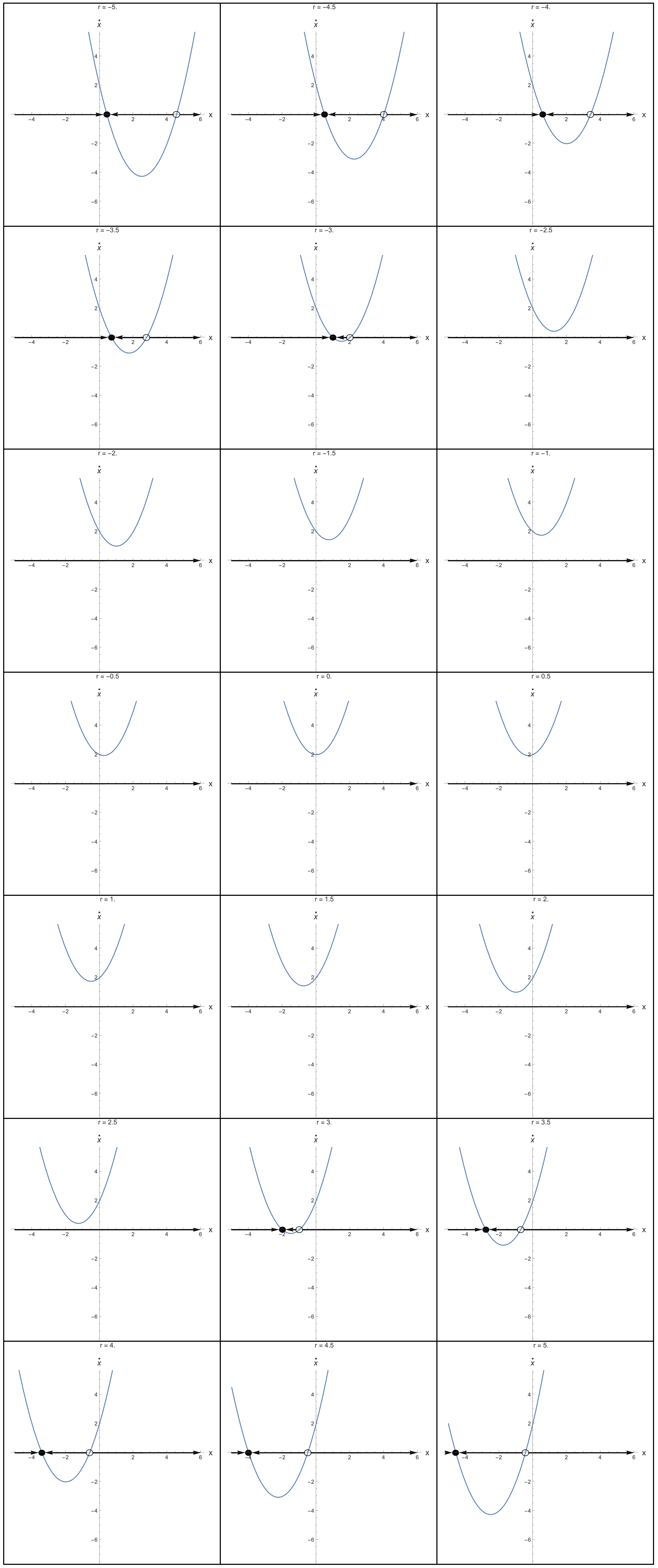
- i) Sketch the different vector field types that appear when you vary $r$. We’re actually going to do this first the hard way, then the easier way.
Looking at the phase portrait for different values of $r$ we get the following.
Now taking the arrows and fixed points alone and plotting them as a vector field:
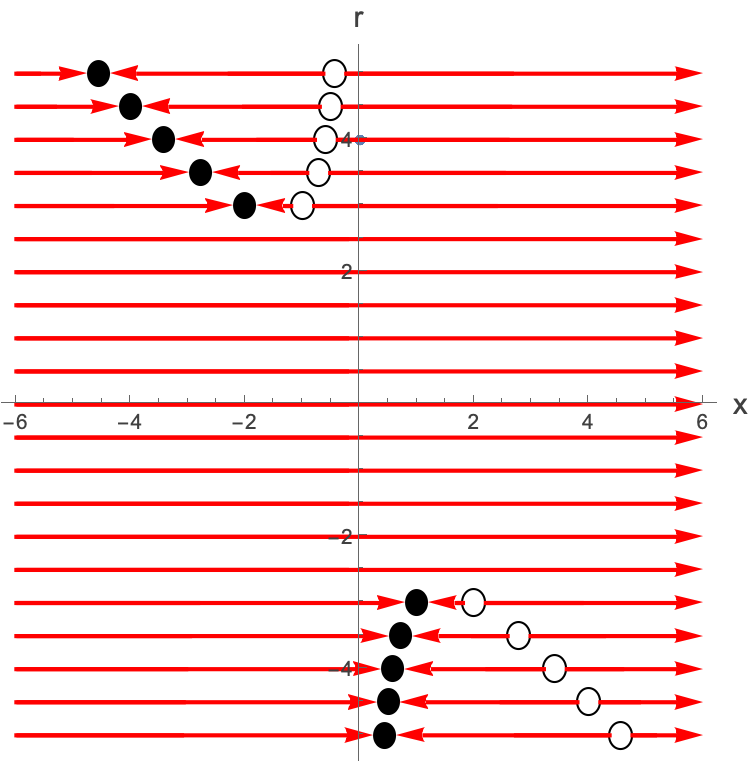
We get the bifurcation diagram by rotating this whole plot above:
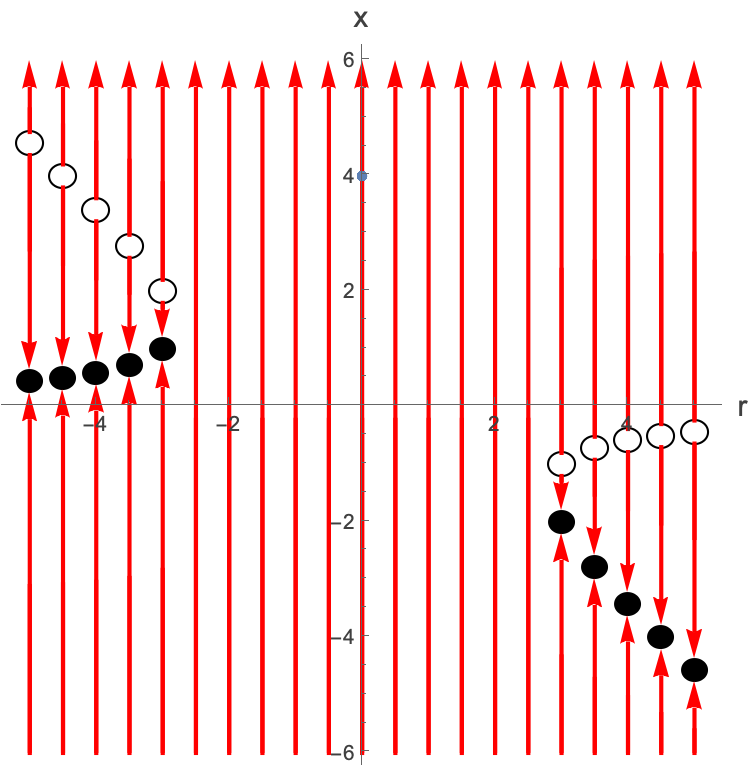
We can actually find these fixed points and thus the bifurcation diagram more simply. We need to solve $\dot{x}=2+r x +x^{2}=0. $This is just a quadratic in $x.$ So the fixed points occur at:
We can plot these fixed points and this gives us
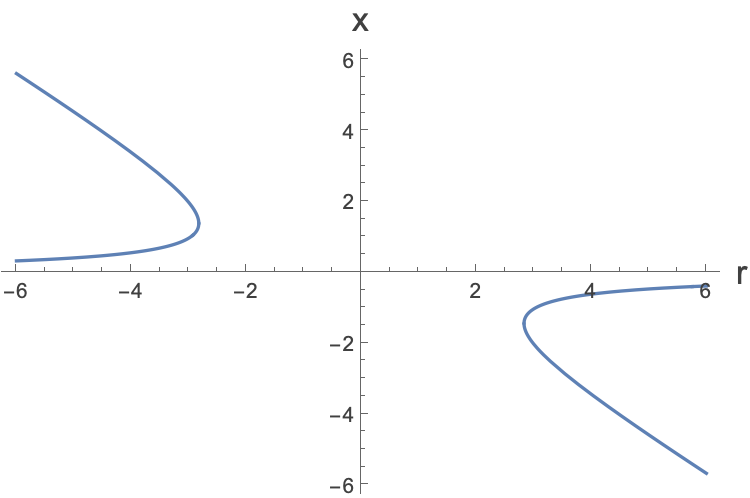
We actually already have whether the fixed points are stable or unstable from the vector field plot above, so let’s put these on:
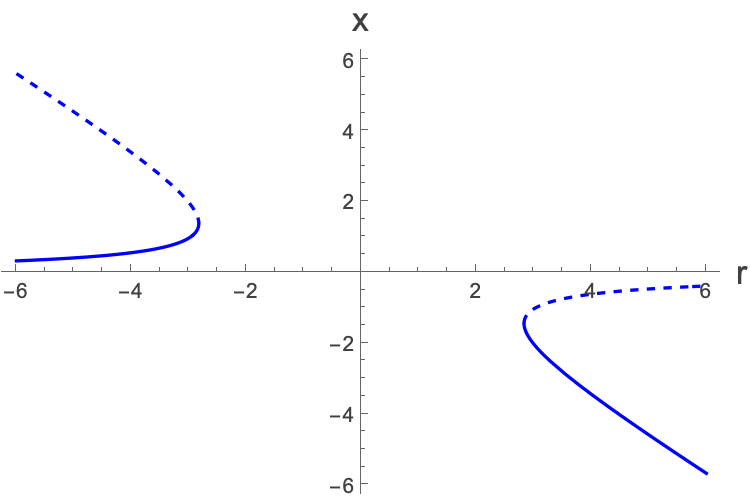
The critical points are when the term inside the square root vanishes (when we go from no fixed points, to one, to two):
Two critical points, at $r = \pm{}2\sqrt{2}$, and these occur at: $x=\frac{1}{2}\left(-r\right)=\mp{}\sqrt{2}$:
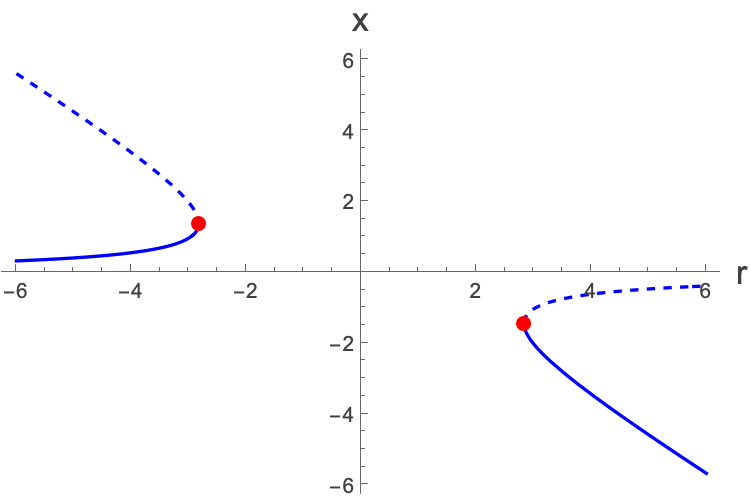
We can actually rewrite the equation very simply to get it into Normal form. Let’s first of all complete the square:
$ \dot{x}=2+r x +x^{2}\longrightarrow{}{\left(x+\frac{r}{2}\right)}^{2}-\frac{r^{2}}{4}+2$
Now redefine $X=x+\frac{r}{2}$:
$ \dot{X}=X^{2}-\frac{r^{2}}{4}+2$
Now and now define: $R=\frac{-r^{2}}{4}+2$ :
$ \dot{X}=R+X^{2}$
Which is the normal form for a saddle-node bifurcation.