9. The argument of a complex number
Here we are going to give the second way of representing a complex number. Every number sits at some point in the complex plane and every point in the complex plane corresponds to a unique complex number. So far we have written these points by their Cartesian representation. ie. what is the real part of the complex number and what is the imaginary part. This representation is one-to-one. I give you a point in the complex plane and you can give me $a+bi$, and vice versa.
Here we're going to see that we can represent them in a different way in the complex plane.
This representation will be written not in terms of $a$ and $b$ denoting the real and imaginary parts, but in terms of the distance of the point in the complex plane from the origin, and the angle subtended between the positive real axis and the line joining the origin to the complex number.
What's going to be very strange here is that this representation will not be one-to-one.
Let's take an example here. Given the complex number $z=1+i$, we can ask what angle $\theta$ does the line between 0 and $z$ make with the positive real axis (going anti-clockwise)? Let's look at this in the complex plane:
For instance, given the complex number $z=1+i$, what angle $\theta$ does it make with the positive real axis, and how far is it from the origin?
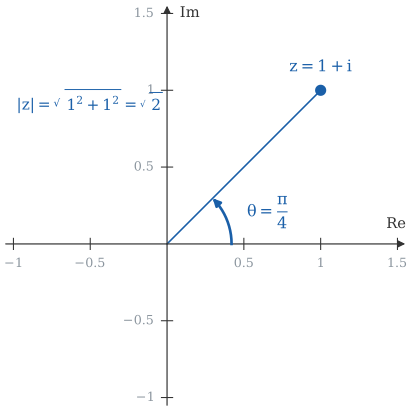
This complex number is $\sqrt{2}$ units away from the origin, and makes an angle of $\theta =\dfrac{\pi}{4}$ counterclockwise from the positive real axis.
What this means is that if I had simply told you to locate the number in the complex plane which is modulus $\sqrt{2}$ and makes angle $\frac{\pi}{4}$ with the positive real axis, you would be able to uniquely pinpoint where this number was and you could tell me that it has real part 1 and imaginary part 1. ie it is $z=1+i$.
This tells us that there is a mapping from $(|z|,\theta)\rightarrow (Re(z),Im(z))$.
The angle $\theta$ is called an argument of the complex number. What's strange is that while giving $|z|$ and $\theta$ will give me a unique point in the complex plane, there are an infinite number of different $\theta$'s which correspond to the same point. The reason for this is that, for instance with $z=1+i$, although we went counterclockwise from the positive real axis an angle $\frac{\pi}{4}$, we could also have gone $\frac{\pi}{4}+2\pi$ and we would have ended up at the same place:
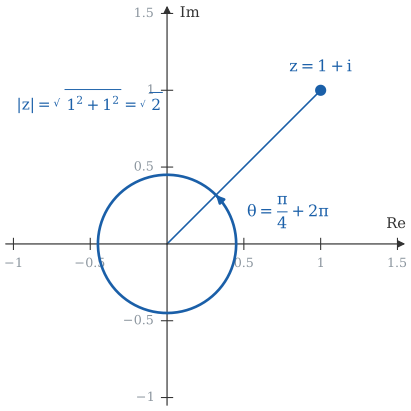
In fact we could have gone round any number of full rotations. This tells us that if we said where is the number with modulus $\sqrt{2}$ and with angular position $2\pi+\frac{\pi}{4}$ it would also be $z=1+i$. Thus, this representation is not one-to-one with the points in the complex plane.
Here we can define the argument of a complex number as follows:
An argument of a complex number $z$
An argument of a non-zero complex number $z$ is an angle $\theta$ measured from the positive real axis to the line segment joining $z$ to the origin.
The set of all possible arguments, denoted by $arg(z)$, can be written as: $$arg(z)= \{ Arg(z) + 2\pi k \quad | \quad k \in \mathbb{Z} \}$$
where $Arg(z)$ is called $\textbf{the principal value of the argument}$ satisfying $-\pi< Arg(z) \leq \pi$.
This means that $arg(z)$ is an infinite set, and $Arg(z)$ is a single number.
You might ask why we are introducing another way of denoting complex numbers where the Cartesian Form seemed just fine, thank you very much. Well, it turns out that many things will be much easier in the language of the modulus and the argument as we will see in the following sections.
We want to be able to calculate $Arg(z)$ wherever $z$ is in the complex plane. In order to do this it depends on which quadrant of the complex plane the number is in.
If $z=a+bi$ and $\theta =\arctan\big({\dfrac{b}{a}}\big)$ then
$$ Arg(z) = \begin{cases} \theta & \text{If $z$ is in the first or fourth quadrants} \\ \theta + \pi & \text{If $z$ is in the second quadrant} \\ \theta - \pi & \text{If $z$ is in the third quadrant} \end{cases} $$
Plot the following numbers in the complex plane and find $|z|$, $Arg(z)$ and $arg(z)$ for:
- $z=1+i$
- $z=1-i$
- $z=-\sqrt{3}-i$
- $z=-1+\sqrt{3}i$
- $z=i$
- $z=2$
- $z=-\pi$
Show solutions
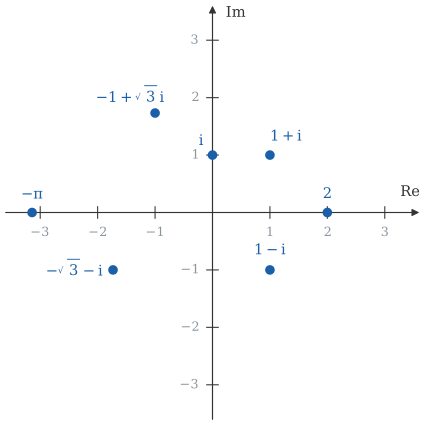
- For $z=1+i$, $|z|=\sqrt{1^2+1^2}=\sqrt{2}$, $Arg(z)=\frac{\pi}{4}$, $arg(z)=\{\frac{\pi}{4}+2\pi k |k\in\mathbb{Z}\}$
- $z=1-i$, $|z|=\sqrt{1^2+(-1)^2}=\sqrt{2}$, $Arg(z)=-\frac{\pi}{4}$, $arg(z)=\{-\frac{\pi}{4}+2\pi k |k\in\mathbb{Z}\}$
- $z=-\sqrt{3}-i$ $|z|=\sqrt{(-\sqrt{3})^2+(-1)^2}=2$, $Arg(z)=-\frac{5\pi}{6}$, $arg(z)=\{-\frac{5\pi}{6}+2\pi k |k\in\mathbb{Z}\}$
- $z=-1+\sqrt{3}i$ $|z|=\sqrt{(-1)^2+(\sqrt{3})^2}=2$, $Arg(z)=\frac{2\pi}{3}$, $arg(z)=\{\frac{2\pi}{3}+2\pi k |k\in\mathbb{Z}\}$
- $z=i$, $|z|=\sqrt{1^2}=1$, $Arg(z)=\frac{\pi}{2}$, $arg(z)=\{\frac{\pi}{2}+2\pi k |k\in\mathbb{Z}\}$
- $z=2$, $|z|=\sqrt{2^2}=2$, $Arg(z)=0$, $arg(z)=\{2\pi k |k\in\mathbb{Z}\}$
- $z=-\pi$, $|z|=\sqrt{(-\pi)^2}=\pi$, $Arg(z)=\pi$, $arg(z)=\{\pi+2\pi k |k\in\mathbb{Z}\}$
Find $Arg(z)$ and $arg(z)$ if:
- $\sqrt{3}+i$
- $1-\sqrt{3}i$
- $8i$
- $-1+i$
- $-3-3i$
Sketch the following subsets of the complex plane
- $\{z \in \mathbb{C}: 0 \leq Arg(z) \leq \frac{\pi}{2}\}$
- $\{z\in \mathbb{C}: \frac{\pi}{4} \leq Arg(z) \leq \frac{\pi}{2}$ and $2<|z| \leq 3\}$