8. Properties of the conjugate and modulus
Just as we did for multiplication and addition of complex numbers, we can write down the properties of the complex conjugate, all of which can be proved from its definition, and the definition of the arithmetic procedures of complex numbers:
Properties of the complex conjugate
If $z,w \in \mathbb{C}$ and $n \in \mathbb{Z}^{+}$, then
- $\overline{z+w}=\overline{z}+\overline{w}$
- $\overline{zw}$=$\overline{z}$ $\overline{w}$
- $\overline{\Big(\dfrac{z}{w}\Big)}$=$\dfrac{\overline{z}}{\overline{w}}$ for $w\neq 0$
- $z\overline{z}=|z|^2$
- $z+\overline{z}=2Re(z)$
- $z-\overline{z}=2iIm(z)$
- $\overline{\overline{z}}=z$
- $\overline{(z^n)}=(\overline{z})^n$
We will prove properties 8.1(a) and 8.1(h) and leave the rest for Check your understanding exercises.
Proof of property 8.1(a): Let $z=a+ib$ and $w=c+id$ where $a,b,c,d \in \mathbb{R}$.
$$\begin{aligned}\overline{z+w}&=\overline{(a+ib)+(c+id)}\\ &=\overline{(a+c)+i(b+d)} && \textbf{Definition \href{../sec6-arithmetic-operations/#defn-6-1}{6.1}(a)}\\ &=(a+c)-i(b+d) && \textbf{Definition \href{../sec7-identities-inverses-and-division/#defn-7-2}{7.2}(a)}\\ &=(a-ib)+(c-id) && \textbf{Definition \href{../sec6-arithmetic-operations/#defn-6-1}{6.1}(a)}\\ &=\overline{a+ib}+\overline{c+id} && \textbf{Definition \href{../sec7-identities-inverses-and-division/#defn-7-2}{7.2}(a)}\\ &=\overline{z}+\overline{w} \quad \Box\end{aligned}$$Proof of property 8.1(h): We will prove this by mathematical induction.
Let $P(n)$ be the proposition that $\overline{(z^n)}=(\overline{z})^n$ for $n \in \mathbb{Z}^+$
Base Case: When $n=1$ the matter is clear.
Induction Hypothesis: Assume that $P(k)$ is true for some $k \in \mathbb{Z}^+$ i.e. $\overline{(z^k)}=\overline{(z)}^k$.
Induction Step: We will now show that $P(k+1)$ holds true i.e. $\overline{(z^{k+1})}=(\overline{z})^{k+1}$
$$\begin{aligned}\overline{(z^{k+1})}&= \overline{(z^kz)}\\ &=\overline{(z^k)}\overline{z} && \textbf{Property \href{../sec8-conjugate-and-modulus/#prop-8-1}{8.1}(b)}\\ &=\overline{z}^k\overline{z} && \textbf{By the Induction Hypothesis}\\ &=\overline{(z)}^{k+1}\end{aligned}$$So $P(k+1)$ is correct. Hence by the principle of mathematical induction $P(n)$ is true for all $n \in \mathbb{Z}^+$.
For the modulus of a complex number we have
Properties of the modulus
If $z$ and $w$ are complex numbers, then:
- $z\overline{z}=|z|^2$
- $|\overline{z}|=|z|$
- $|z|\geq 0$
- $|z|=0$ if and only if $z=0$
- $|z-w|$ is the distance between the points $z$ and $w$ in the complex plane.
- $|zw|=|z||w|$
- $|z|+|w| \geq |z+w|$ (The triangle inequality)
Notice that this is the first time we see inequalities in our discussion of complex numbers. This is because the quantity $|z|$ is a real number, and real numbers can be ordered. The reason why we don't discuss inequalities for complex numbers is because they cannot be "ordered".
Real numbers possess an ordering relation i.e. they can be ordered. The axioms of order in real numbers are:
- If $a \in \mathbb{R}$ and $a \neq 0$ then either (but not both) $a>0$ or $a<0$.
- If $a,b \in \mathbb{R}$ and $a,b>0$, then $ab>0$.
If $a,b \in \mathbb{R}$ and $a,b>0$, then $a+b>0$.
Unlike real numbers, the complex numbers cannot be ordered, that is, there is no ordering satisfying axioms 1 to 3 compatible with the structure of complex numbers. For if there were such an ordering, since $i\neq0$ then we must must have either $i>0$ or $i<0$ by $(1)$. But if $i>0$ then $i\times i>0$ by (2), that is, $-1>0$ which is a contradiction. Similarly if $i<0$, then $-i>0$, by (2) we have $-i \times -i >0$, again $-1>0$ which is a contradiction.
The proof of the triangle inequality is probably the hardest of the basic properties to prove, so make sure that you understand every step.
Proof of Property 8.2(g) proof:
$$\begin{aligned}|z+w|^2&=(z+w)(\overline{z+w})\\ &=(z+w)(\overline{z}+\overline{w})\\ &=z\overline{z}+w\overline{z}+z\overline{w}+w\overline{w}\\ &=|z|^2+w\overline{z}+z\overline{w}+|w|^2\\ &=|z|^2+\overline{z\overline{w}}+z\overline{w}+|w|^2\\ &=|z|^2+2Re(z\overline{w})+|w|^2\\ &\leq |z|^2+2|z\overline{w}|+|w|^2\\ &\leq|z|^2+2|z||\overline{w}|+|w|^2\\ &\leq|z|^2+2|z||w|+|w|^2\\ &\leq(|z|+|w|)^2.\end{aligned}$$$\Box$
Find the distance between the given complex numbers and the origin i.e. find the modulus of $z$ if:
- $z=1+i$
- $z=1-\sqrt{3}i$
- $z=a+b-i(a-b)$
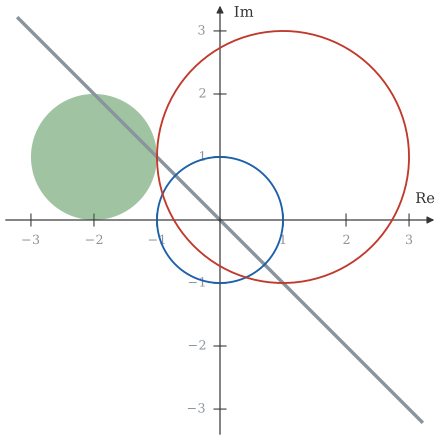
Draw a sketch of the set of all $z \in \mathbb{C}$ such that:
- $|z|=1$
- $|z-(i+1)|=2$
- $|z-i|=|z+1|$
- $|z+2-i|\leq 1$
Show solutions
The modulus of a complex number is its distance from the origin, so we just have to calculate that.
- If $z=1+i$ then $|z|=|1+i|=\sqrt{1^2+1^2}=\sqrt{2}$
- If $z=1-\sqrt{3}i$ then $|z|=|1-\sqrt{3}i|=\sqrt{1^2+\sqrt{3}^2}=\sqrt{1+3}=2$
- If $z=a+b-i(a-b)$ then $|z|=|a+b-i(a-b)|=\sqrt{(a+b)^2+(a-b)^2}=\sqrt{2(a^2+b^2)}$
Draw a sketch of the set of all $z \in \mathbb{C}$ such that:
- $|z|=1$. That is, which points in the complex plane are a distance 1 from the origin? This is just the unit circle.
- $|z-(i+1)|=2$. Remember that the modulus of $z-w$ is the distance between the complex numbers $z$ and $w$ in the complex plane, so this is asking for all points $z$ which are a distance 2 away from $(1+i)$, that is a circle of radius 2 about the point $(1+i)$.
- $|z-i|=|z+1|$. This is asking for those points $z$ which are the same distance away from $i$ as they are from the point -1. Of course the point right in between these points is one such $z$ but in fact there is a whole line of them as can be seen in the figure
- $|z+2-i|\leq 1$. This is all points $z$ less than 1 unit away from the point $(-2+i)$, which corresponds to a unit disk centred on the points $(-2+i)$.
Each of the above could also have been solved by setting $z=a+bi$ and expanding the modulus, then equating real and imaginary parts of both sides. This would give two equations in the two unknowns $a$ and $b$ which can be solved for. Try this and make sure that you get the same answers.
Find the modulus of the following complex numbers:
- $2-5i$
- $-2i$
- $2+\pi$
- $-1+2\sqrt{2}i$
- $-1-\sqrt{2}$
- If $w=1-2i$ and $z=2+3i$, find $||w|-\overline{z}|$.
Describe and sketch the following subsets of the complex plane:
- $\{ z \in \mathbb{C}|\ 5<|5z+10i|<10\ \}$
- $\{ z \in \mathbb{C}|\ |\overline{z}+4|\geq|2+iz|\ \}$
- $\{ z \in \mathbb{C}|\ |z-(1+2i)|=1\ \}$
- $\{ z \in \mathbb{C}|\ Re(z)+Im(z) \geq 0\ \}$
- $\{ z \in \mathbb{C}|\ |z+i|=|z+1|\ \}$
- $\{ z \in \mathbb{C}|\ |z+i| \leq 1\ $ and $ |z+1| \leq 1\ \}$
- Show that the complex numbers satisfying $Re\big(\dfrac1{z}\big)=\dfrac1{2}$ where $z \in \mathbb{C}$ form a circle. Give it's center and radius.
Show answer
Center (1,0) radius 1
- If $z=a+bi$, where $a,b \in \mathbb{R}$, $b \neq 0$, and $|z|=1$, show that $$\dfrac{z-1}{z+1}$$ is purely imaginary.
- If $z+\dfrac1{z}$ is real, where $z \in \mathbb{C}$, prove that $|z|=1$ or $z$ is real.
- Prove Properties 8.1 and 8.2
The definition of the relation $>$ in the real number system is based upon the existence of a subset $\mathscr{P}$ (the positive reals) having the following properties:
(i)For any real number $\alpha \neq 0$, either $\alpha$ or $-\alpha$ (but not both) belongs to $\mathscr{P}$.
(ii) If $\alpha$ and $\beta$ belong to $\mathscr{P}$, so does $\alpha + \beta$.
(iii) If $\alpha$ and $\beta$ belong to $\mathscr{P}$, so does $\alpha \times \beta$.When such a set $\mathscr{P}$ exists we write $\alpha > \beta$ if and only if $\alpha-\beta$ belongs to $\mathscr{P}$. Prove that the complex number system does not possess a non-empty subset $\mathscr{P}$ having properties (i),(ii), and (iii).