7. Identities, inverses and division of complex numbers
We need to make some more definitions at this point:
Identities and inverses
- The additive identity for complex numbers is a number, call it $w$, such that $z+w=w+z=z$ for any complex number $z$. It becomes clear that $0+0i$ (or simply $0$) is the additive identity since $z+0=z=0+z$ for any complex number $z$.
- The additive inverse of a complex number $z$, let's again call it $w$, is a number such that if you take any number, and add $z$ to it, then add $w$ to it, you get back to the original number. We can actually write this as: $z+w=0$. ie. $w=-z$. More explicitely, given $z=a+bi$, the additive inverse is $w=-a-bi$.
- The multiplicative identity is that number which, when you multiply it by complex number, that number remains the same. ie. if we call the multiplicative identity $w$, then for any $z\in\mathbb{C}$ we must have that $wz=zw=z$, and this number is just $w=1$.
We'll give a whole box to the next one as it definitely takes a bit more thought.
[4.]The other thing that we need to think about is the multiplicative inverse.
Let's first think about the multiplicative inverse for real numbers. What is the multiplicative inverse of 2? We call it $2^{-1}$ and it's the number that you have to multiply 2 by to get to 1, which is clearly 0.5. We can write this as:
$$2^{-1}2=1\implies 2^{-1}=0.5$$
How about for complex numbers? What is the multiplicative inverse of $z=a+bi$, $a,b\in\mathbb{R}$? Let's call it $z^{-1}=c+di$, $c,d\in\mathbb{R}$ and it must have the property such that:
$$z z^{-1}=z^{-1}z=1$$
In fact we only need to deal with one of $z z^{-1}$ or $z^{-1}z$ because we saw that complex numbers commute under multiplication.
Let's figure out what the $c$ and $d$ have to be in terms of $a$ and $b$. Remember, we are given $z$ and we have to figure out what is $z^{-1}$. Let's write the whole thing out:
$$zz^{-1}=(a+bi)(c+di)=ac-bd+i(ad+bc)$$
and we want this to equal 1. Well, for this to be 1, we must have that $ac-bd=1$ and $ad+bc=0$. We can solve this for $c$ and $d$ and we find:
$$c=\frac{a}{a^2+b^2}\, ,\,\,\,\, d=\frac{-b}{a^2+b^2}$$
or
$$z^{-1}=\frac{a-bi}{a^2+b^2}$$
In fact we can therefore write:
$$z^{-1}=\frac{1}{a+bi}=\frac{a-bi}{a^2+b^2}$$
Clearly, $z^{-1}$ only exists if $a$ and $b$ are not both zero, in other words, if $z\neq0$.
You might ask why we can't just write that
$$z^{-1}=\frac{1}{a+bi}$$
Indeed this is quite correct, but it gives you no idea about where this number is in the complex plane. In order to put it into Cartesian Form, you need to know what is the real part, and what is the imaginary part, and that is written then explicitely as:
$$z^{-1}=\frac{a}{a^2+b^2}-\frac{b}{a^2+b^2}i$$
or just
$$z^{-1}=\frac{a-bi}{a^2+b^2}$$
This way the number which is the multiplicative inverse of $z=a+bi$ is $\frac{a}{a^2+b^2}$ along the real axis and $\frac{-b}{a^2+b^2}$ along the imaginary axis.
So we can now also divide by complex numbers. Note that while the numerator is complex, the denominator is real, so if I give you a complex number, let's say $z=3-4i$, you can find which number in the complex plane is $\frac{1}{z}$ which in this case will be $$\frac{3}{25}+\frac{4i}{25}$$ and you can pinpoint this in the complex plane. Make sure that you get this when you use the above formula for the multiplicative inverse.
Let's take an example and try and calculate:
$$\frac{2+3i}{3-4i}$$
Well, this is the same as:
$$(2+3i)\frac{1}{3-4i}=(2+3i)\frac{3+4i}{25}=\frac{(6-12)+i(8+9)}{25}=\frac{-6+17i}{25}$$
Actually, we can do something kind of strange here. We can think about our first function of complex numbers. We know how to draw the graph of $y=1/x$. We do this by setting up the $x$ and $y$ axes, and finding the points in the $(x,y)$ plane such that $y=\frac{1}{x}$. What would this mean for complex numbers. Well for real numbers, each axis was one dimensional, and so we ended up with a two dimensional graph. Here, we have a mapping from points in a two dimensional space to points in a two dimensional space, ie:
$$f:a+bi\rightarrow \frac{a-bi}{a^2+b^2}$$
so it kinda looks like this should be four dimensional, ie. all points $(z,w)$ such that $w=\frac{1}{z}$
Well, we can't do this, so instead we put two complex planes next to each other, and ask where entire lines of complex numbers get mapped to. The easiest lines to think about are lines of constant imaginary part (ie. horizontal lines) and lines of constant real part (ie. vertical lines). It turns out that these lines of points get mapped in a really pretty way to circles of different positions and radii under the map $z\rightarrow \frac{1}{z}$.
There is a mathemafrica blog-post here on plotting functions of complex numbers, the material is not examinable. We recommend reading this blog-post here to see some animated mapping. Below are some plots generated using Mathematica which you will also find in the blog-post.

In the figure above, the colors of each line are matched, and you can see four points which are mapped to their correspondingly colored points in the complex plane.
Actually, when we calculated the multiplicative inverse of $z=a+bi$:
$$z^{-1}=\frac{1}{a+bi}=\frac{a-bi}{a^2+b^2}$$
we found two expressions which will be used frequently and have names of their own, they are called the complex conjugate, and the modulus respectively:
Complex conjugate and modulus
(a) The complex conjugate of the complex number $z=a+bi$ is denoted by $\overline{z}$ and is defined as:
$\overline{z}=a-ib$ (simply change the sign of the imaginary part).
(b) The modulus of a complex number $z=a+bi$, denoted by $|z|$, is defined as:
$|z|=\sqrt{a^2+b^2}$
Note that the modulus of a complex number is just the distance of that number in the complex plane to the point 0.
Remark: Geometrically, the complex conjugate $\overline{z}$ is the reflection of $z$ about the real axis, and the modulus $|z|$ is the length of a line segment joining the origin and the complex number $z$:
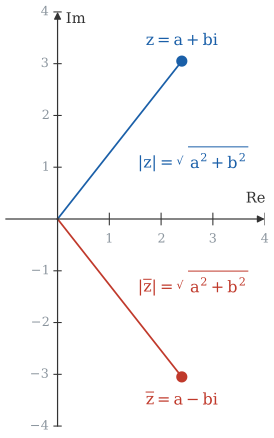
Therefore, in terms of the definitions above, we have $$z^{-1}=\dfrac{a-bi}{a^2+b^2}=\dfrac{\overline{z}}{|z|^2}$$.
We can therefore write the division of complex numbers in terms of the complex conjugate and modulus:
Division of complex numbers
If $z,w \in \mathbb{C} , z \neq 0$, we define the quotient $\dfrac{w}{z}$ as follows:
$$\dfrac{w}{z}=\dfrac{w\overline{z}}{z\overline{z}}=\dfrac{w\overline{z}}{|z|^2}$$
So to divide by a complex number, multiply by its conjugate and divide by its modulus squared.
Remark: Complex numbers are closed under division i.e. if $z,w \in \mathbb{C}$ then $\dfrac{w}{z} \in \mathbb{C}$, provided $z \neq 0$.
Write the following complex numbers in a cartesian form i.e. the form $z=a+ib$
- $\dfrac{1-i}{2+i}$
- $\dfrac{\overline{1+i}}{3-2i}$
- $\dfrac{2+3i}{i(1+i)}$
Show solutions
In each case here we will rationalise the denominator. This just means multiplying top and bottom by the complex conjugate:
- $\dfrac{1-i}{2+i}=\dfrac{(1-i)(2-i)}{(2+i)(2-i)}=\dfrac{1 - 3 i}{5}$
- $\dfrac{\overline{1+i}}{3-2i}=\dfrac{{1-i}}{3-2i}=\dfrac{5-i}{13}$
- $\dfrac{2+3i}{i(1+i)}=\dfrac{2+3i}{(i-1)}=\dfrac{(2+3i)(-1-i)}{(i-1)(-1-i)}=\dfrac{(1 - 5 i)}{2}$
Write the following complex numbers in a cartesian form i.e. form $z=a+bi$ ($a,b \in \mathbb{R}$)
- $\dfrac{2-3i}{1+i}$
- $\dfrac{\overline{3+4i}}{1-i}$
- $\dfrac{(1-i)^2}{2-3i}$
- $\dfrac{\overline{(2-3i)}(1+i)}{\sqrt{3}+i}$
- $\dfrac{(1+i)^2}{2-\sqrt{3}i}$
- Find all real numbers $x$ and $y$ such that $\dfrac1{x+iy}=1+i$.
- If $z=2-i$, write $\dfrac{\overline{z}}{1-z}$ in a form $a+bi$.
- Find the real and the imaginary parts of $$\dfrac1{1+\dfrac{i}{1+i}}$$.
- Simplify $\dfrac{z\overline{z}^2}{|z|^2}$ if $z \in \mathbb{C}$.
Let $z=1-\sqrt{3}i$. Find:
- $|z|$
- $\overline{iz}$
- Re$(\frac1{z})$
- Prove that if $(\overline{z})^2=z^2$, then $z$ is either real or pure imaginary.
- Give a value for $z$ and a value for $w$ for which $|z+w| \neq |z|+|w|$.
- Show that $z\overline{z}=|z|^2$.
- Show why the expressions in (5) and (6) are equal.
- Show that for any complex number $z$, Re$(z) \leq |z|$. Hence, justify the relationship between (6) and (7).
- Deduce from the triangle inequality that $||z|-|w||\leq |z-w|$.