6. Simple arithmetic operations on complex numbers
Well, now we have these new numbers as solutions to simple equations (so far just quadratic), but we want to be able to play all our usual arithmetic games with them. We're going to do this with a definition. This definition is going to be the obvious choice, but still, it's something that we have chosen.
Addition of Complex numbers
Given two complex numbers $z_1=a_1+ib_1$ and $z_2=a_2+ib_2$ where $a_1,b_1,a_2,b_2 \in \mathbb{R}$ then:
we define their Addition as: $z_1+z_2=(a_1+ib_1)+(a_2+ib_2)=(a_1+a_2)+i(b_1+b_2)$
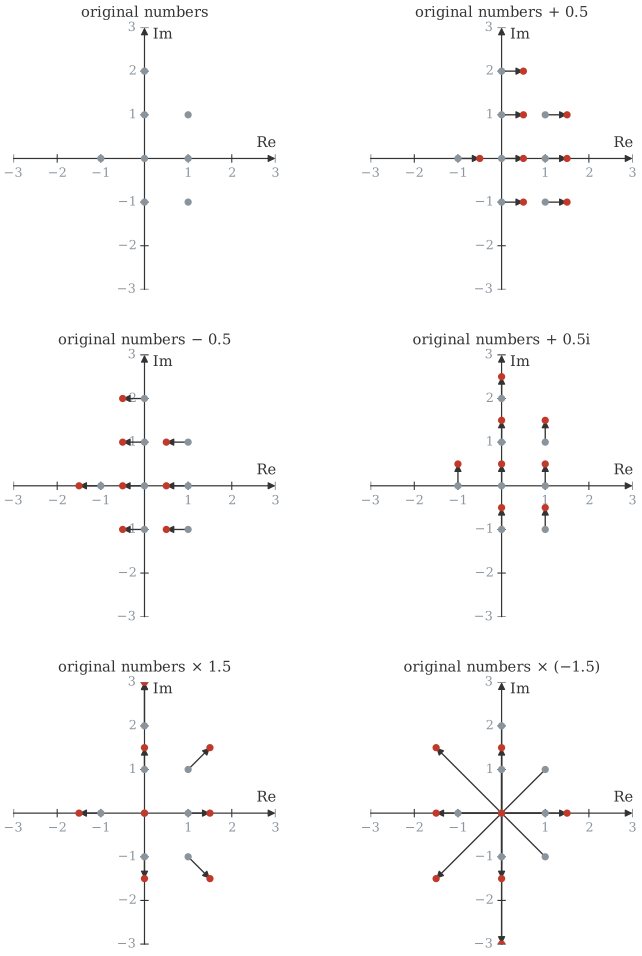
This, I hope seems at least reasonably sensible. If I take two complex numbers and I add them together, then the real part of the new complex number is the addition of the real parts of those that we are adding together, and similarly its imaginary part. Let's see what this looks like in the complex plane:

You see it all looks very geometrical. This means that if we add a real number to any complex number, it just shifts it left and right (depending on the sign), and if we add an imaginary number to any complex number it just shifts it up and down (depending on the sign).
To think about multiplication, we're going to start with the definition of the multiplication of two complex numbers and then we will step back and see what multiplication by a real number means in the complex plane, and then what multiplication by an imaginary number means.
Multiplication of Complex numbers
Given two complex numbers $z_1=a_1+ib_1$ and $z_2=a_2+ib_2$ where $a_1,b_1,a_2,b_2 \in \mathbb{R}$ then:
we define their multiplicative product as: $z_1z_2 =(a_1a_2-b_1b_2)+i(a_1b_2+a_2b_1)$
This looks a bit complicated, but in fact we can see that it comes from:
$$z_1z_2 = (a_1+ib_1)(a_2+ib_2)=a_1a_2+ia_1b_2+ia_2b_1+i^2b_1b_2 = (a_1a_2-b_1b_2)+i(a_1b_2+a_2b_1)$$
We write $z_1z_2$ to mean the product of $z_1$ and $z_2$ just as we would do for two real numbers $x_1$ and $x_2$.
Ok, so that's a bit complicated for the moment. Let's just look at multiplication of a complex number by a real number:
Given $r\in\mathbb{R}$ and $z=a_1+i b_1$, we have:
$$r z=ra_1+i r b_1$$
So in terms of the complex plane this will just scale both the real and imaginary parts by a factor of $r$ towards or away from the origin depending on whether $r$ is less than or greater than 1, and will perform a reflection about the real and imaginary axes if $r$ is negative.
Let's just think a bit more about what arithmetic operations look like in the complex plane. We are going to start with a load of random complex numbers and see what happens to them when we perform some operation. Let's start with the following complex numbers:
$$-1,0,1,-i,i,1+i,1-i,2i$$
In the following figure we first see these points placed in the complex plane, and then we add real and imaginary numbers to them to see how they move, and then multiply by positive and negative real numbers to see what happens.
What would happen to these numbers if we multiplied not be a real number but by an imaginary number?
Well, let's calculate what will happen if we multiply them all by $i$.
$$\times i: (-1,0,1,-i,i,1+i,1-i,2i)\rightarrow (-i,0,i,1,-1,i-1,i+1,-2)$$
Let's look at this mapping in the complex plane.

We see that multiplying by $i$ corresponds to a rotation by $\frac{\pi}{2}$ radians anticlockwise about the origin. This is actually exactly what we saw before when we asked how we could multiply by -1 in two equal steps...we said that we had to do this via two rotations. Now we see the link between the arithmetic and the geometry.
What about multiplying by $2i$? Well, this is the same as multiplying by $i$ and then multiplying by 2; so it's a rotation and a scaling.

Now we can say that in the complex plane:
- addition by a real number shifts left and right
- addition by an imaginary number shifts up and down
- addition by a complex number with both real and imaginary parts does a bit of both of the above
- multiplication by a real number scales towards or away from the origin and reflects about the real and imaginary axis if the number is negative.
- multiplication by an imaginary number rotates left and right and scales, and may reflect as above if it is $i$ times a negative real number.
In fact, given the above, we can think of multiplication by -1 not as reflection across the imaginary axis, but as $-1=i\times i$ therefore rotation about the origin counterclockwise by $\frac{\pi}{2}$ twice, ie. by $\pi$. Of course we could also think of it as $-1=(-i)\times(-i)$ ie. the same thing but clockwise rather than counterclockwise.
Now let's give you something to investigate:
- choose any number in the complex plane which is a distance 1 away from the origin, but not a simple one like 1, or $i$, etc. You can find these by drawing a unit circle about the origin and picking any point on it.
- Write down this number in the form $a+ib$, with $a$ and $b\in\mathbb{R}$.
- Note that if it's on the unit circle then you should have $a^2+b^2=1$. Check that you do!
- Work out what is the angle subtended between the positive real axis, and the line joining the origin to your number, going in the counterclockwise direction.
- Take the numbers that we looked at before (ie. $(-1,0,1,-i,i,1+i,1-i,2i)$) and multiply them by this number.
- What has happened to all of these numbers? Ho does this relate to the angle that you found in step 4?
One really important thing to note here is that:
Complex numbers are closed under addition and multiplication i.e. if $z_1,z_2 \in \mathbb{C}$ then so is $z_1+z_2$ and $z_1z_2$.
This means that we don't have to worry about a different kind of number suddenly appearing. As long as we are doing regular arithmetic, so long as I give you a bunch of complex numbers, you can't find yourself in some unknown realm of numbers.
Now is a moment to step back and remember that we are in Mathemafrica, and we have the freedom to make certain choices and then explore those choices. Above we have simply defined addition and multiplication of two complex numbers. Now we can find out the consequences of this. We have to figure out what are the properties of addition and multiplication of two or more complex numbers having made the above choice.
The above definitions are what we can think of as axioms in this system. They can't be proven, they are simply the basic definitions that we've decided to give our new ingredients. Anything which comes from this in the form of properties or theorems must be proven.
Below we will postulate (this is like a guess, before we have proved something) the properties which come out of the above definitions. Each of them can be proven, and we will prove one of them below. All you need to prove them are the definitions of addition and multiplication of complex numbers along with the properties of the addition and multiplication of real numbers.
Common arithmetic properties of complex numbers
If $z, z_1, z_2, z_3 \in \mathbb{C}$, then:
- Commutative property of addition: $z_1+z_2=z_2+z_1$
- Commutative property of multiplication: $z_1z_2=z_2z_1$
- Associative property of addition: $z_1+(z_2+z_3)=(z_1+z_2)+z_3$
- Associative property of multiplication: $z_1(z_2z_3)=(z_1z_2)z_3$
- Distributive property: $(z_1+z_2)z_3=z_1z_3+z_2z_3$
- Additive Identity: $\boldsymbol{0}+z=z$
- Multiplicative Identity: $\boldsymbol{1}z=z$
- Additive Inverse: $z+(\boldsymbol{-z})=0$
- Multiplicative Inverse: $zz^{-1}=1$ (provided $z \neq 0$)
We will prove property 6.1(a) and leave the rest for homework exercises (we will frequently prove a few properties and leave the rest for Check your understanding exercises).
Property 6.1(a) proof: Let $z_1=a_1+ib_1$ and $z_2=a_2+ib_2$ for $a_1,a_2,b_1,b_2 \in \mathbb{R}$
$$\begin{aligned}z_1+z_2&=(a_1+ib_1)+(a_2+ib_2)\\ &=(a_1+a_2)+i(b_1+b_2) && \textbf{Definition \href{../sec6-arithmetic-operations/#defn-6-1}{6.1}}\\ &=(a_2+a_1)+i(b_2+b_1) && \textbf{Commutative property of addition for real numbers}\\ &=(a_2+ib_2)+(a_1+ib_1) && \textbf{Definition \href{../sec6-arithmetic-operations/#defn-6-1}{6.1}}\\ &=z_2+z_1 \quad \Box\end{aligned}$$- Solve for $z \in \mathbb{C}$ if $z^2=1+4\sqrt{3}i$. Hint: Let $z=x+iy$ for $x,y \in \mathbb{R}$
Simplify the following:
- $(5-2i)+(1+3i)$
- $(1+i)-(3-2i)$
- $(1+2i)(3-i)$
- $i(2-3i)+(1+4i)$
Show solutions
Letting $z=x+iy$ we have:
$$(x+iy)^2=1+4\sqrt{3}i$$
Expanding out the left hand side gives us:
$$x^2-y^2+2ixy=1+4\sqrt{3}i$$
Make absolutely sure that you can get this! Now, for two complex numbers to be equal (ie. the left and right hand sides), their real parts and imaginary parts must separately be equal. The real part of the left is $x^2-y^2$ and that of the right is 1, while the imaginary parts for each side are $2xy$ for the left, and $4\sqrt{3}$ for the right. Equating them gives us two equations:
$$x^2-y^2=1\, ,\,\,\,\, 2xy=4\sqrt{3}$$
This is two equations in two unknowns and we can solve this. Remember $x$ and $y$ are real so we are just doing regular algebra at this point. Finding the two real solutions to the above two equations and replacing them in $z=x+i y$ we have:
$$z=-2-\sqrt{3}i\, , \,\,\, z=2+\sqrt{3}i$$
In each of these cases we will just be collecting the real and imaginary parts together:
- $(5-2i)+(1+3i)=6+i$
- $(1+i)-(3-2i)=-2+3i$
- $(1+2i)(3-i)=5+5i$
- $i(2-3i)+(1+4i)=2i+3+1+4i=4+6i$
- By first writing $z=a+bi$ (where $a,b \in \mathbb{R}$) solve the equation: $z^2=8+6i$
Show answer
z=3+i or z=-3-i
- Solve for the real numbers $x$ and $y$ such that $(3+2i)x+(2-i)y=7i$
Evaluate the following expressions and write your answer in the cartesian form i.e. form $a+bi$
- $(5-6i)+(3+2i)$
- $(1+2i)-(2-3i)$
- $(2+5i)(4-i)$
- $(2+3i)(1+i)(2-3i)$
- $(1+i)-(2+3i)(1+i)$
- $(1+\sqrt{3}i)(1-\sqrt{3}i$)
- Show that $(a+bi)(a-bi)=a^2+b^2$ where $a,b \in \mathbb{R}$ is a real number.
- Find the real numbers $x$ and $y$ that satisfy the equation: $x-y+2(x+y-1)i=5+4i$.
Show answer
x=4 and y=-1
- Prove properties 6.1(b) to (e).