5. The Complex Plane
We've added an extra axis to the real number line and found ourselves in a two dimensional space. We can pin-point on here any real number and any multiple of $i$, but it feels like a great waste of space. What about the numbers which aren't on either axis?
Well, let's look at an equation like:
$$x^2+2x+2=0$$
We are going to solve this by completing the square. This can be written as:
$$(x+1)^2+1=0$$
or
$$(x+1)^2=-1$$
But we know that the numbers which square to give -1 are $\pm i$, so it must be true that:
$$(x+1)=\pm i$$
So what is $x$? Well, we we just use our normal rules of manipulating equations and take the 1 to the other side to give:
$$x=-1\pm i$$.
So what's the answer? Well, that is $x=-1\pm i$. There's no way to simplify this any further. It's a number which has a real part to it: -1 and an imaginary part to it $\pm i$. You can check that this is a solution by plugging it back into the original equation and finding that the equation is satisfied.
One thing to note here is that by completing the square, we never found ourselves in a position where we had to take the square root of -1. We haven't defined this object. Sometimes you will see it written that $i=\sqrt{-1}$, but we are defining $i$ instead as a number which, when squared gives $-1$. We haven't needed to extend the domain of the square root function to include negative numbers.
So Where do these two numbers sit in this new two-dimensional plane? Well, at the point you get to if you move -1 along the real axis and up or down one unit along the imaginary axis:
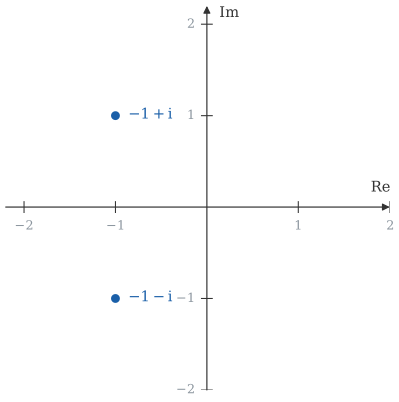
Numbers of this form, with a real part, and an imaginary part are called complex numbers.
Complex numbers
A complex number $z$ is any expression of the form $z=a+bi$, where $a$ and $b$ are real numbers and $i$ is the imaginary unit that satisfies $i^2=-1$.
Two complex numbers $a_1+ib_1$ and $a_2+ib_2$ are said to be equal (i.e. $a_1+ib_1 = a_2+ib_2$) if and only if $a_1=a_2$ and $b_1=b_2$.
For a complex number $z=a+bi$, $a$ is called the real part of $z$ and is denoted by $\boldsymbol{Re(z)}$ i.e. $Re(z)=a$, while $b$ is called the imaginary part of $z$ and is denoted by $\boldsymbol{Im(z)}$ i.e. $Im(z)=b$.
The set of all complex numbers is denoted by $\mathbb{C}$.
Note that a complex number with no imaginary part is just a real number, and so real numbers are also a special type of complex number (just with $Im(z)=0$), and similarly a complex number with $Re(z)=0$ is just an imaginary numbers.
We have a bit of a hierarchy of sets that we can think about now. Just as the integers are a subset of the real numbers we can write:
$$\mathbb{N}\subset \mathbb{Z}\subset\mathbb{Q}\subset\mathbb{R}\subset\mathbb{C}$$
It turns out that there are actually even bigger sets that form the totality of all "normed divisor algebras" but we definitely don't need to worry about what that means, these sets form four dimensional and eight dimensional spaces and are called the quaternions and octionions respectively.
We can think about the complex numbers as ordered pairs, just like we have $(x,y)$ coordinates, we here have the real part and the imaginary part and can write a complex number as $(Re(z),Im(z))$. As always there are multiple ways to write the same thing and it's useful to be able to do so in as many ways as you can.
One thing that we should notice about the two dimensional space (called The Complex Plane, or Argand Plane) is that even though the imaginary axis corresponds to imaginary numbers, we write 1, 2, 3, etc. on it, and not $i$, $2i$, $3i$ etc. because the number denotes how many units of $i$ we have. Moving 1 along the imaginary axis means moving one unit of $i$.
Note that we have here written our complex numbers in a specific form: $z=a+bi$. It turns out that there are going to be other ways to write the same complex number. This particular form we call the Cartesian Form, because it will be easy to represent where the complex number is as a set of cartesian coordinates where the horizontal distance from the origin is $a$ and the vertical distance from the origin is $b$. We will later study the other ways of writing it in detail.
Solve the following equations by completing the square where necessary. You should never need to take the square root of -1.:
- $x^2+9=0$
- $x^2+2x+2=0$
- $x^4-1=0$
- Show that $i^n$, where $n$ is a non-negative integer, can only take on one of four values.
Show solutions
:
To solve $x^2+9=0$ we write: $$x^2=-9$$ dividing both sides by 9 and taking it inside the square we get $$\left(\frac{x}{3}\right)^2=-1$$ But we know that the number which when squared gives -1 must be $\pm i$ and so
$$\frac{x}{3}=\pm i\implies x=\pm 3i$$
Plug it back into the formula to make sure that it does indeed solve the equation
- For this example we do need to complete the square: $$x^2+2x+2=0\implies (x+1)^2+1=0\implies (x+1)^2=-1$$ Using the same logic as in the previous example we know that the number which we've squared must be $\pm i$ and so: $$(x+1)=\pm i \implies x=-1\pm i$$
This is a quartic equation but it's one that we can solve. First we write that: $$x^4=1$$ which implies that $x^2=\pm 1$. We can deal with each of these two cases separately. For $x^2=1$, we just have $x=\pm 1$ and for $x^2=-1$ we have that $x=\pm i$, so overall the solutions are:
$$x=-1,1,i,-i$$
- Let's look at some simple cases to get the idea. If $n=1$ we have $i^1=i$. For $n=2$ we have $i^2=-1$. For $n=3$ we have $i^3=i*i^2=-i$ and for $n=4$ we have $i^n=i^2* i^2=-1*-1=1$. Now we get to five and something interesting happens, we have $i^5=i*i^4=i$ which is the same as for $n=1$. In fact we can take any $n>5$ and always write $i^n=i^{n-4}*i^4=i^{n-4}$. So we can always connect an $i^n$ with one with a lower $n$. In fact we can subtract any number of $4k$'s where $k$ is an integer and $n-4k>=0$ until we get to a $k$ such that $1\le n-4k\le 4$ and we get to one of the four values that we've seen above, ie. $i,-1,-i,1$. Note that $n=0$ is the same as $n=4$, so we could also have shown that all values of $n$ are equivalent to $n=0,1,2,3$ rather than $n=1,2,3,4$.
- Find the value of $i^5$.
Show answer
i
- Simplify $i^{100}$.
Show answer
1
Solve the following equations:
- $x^2+4=0$
Show answer
x=2i or -2i
- $4x^2+9=0$
Show answer
x=3i/2 or x=-3i/2
- $x^2-2x+2=0$
Show answer
x=1-i or 1+i
- $x^2+4=0$