4. Another perspective on addition and multiplication
Let's look at this object in a slightly different way. The more ways we can look at the same thing, the clearer it will all be in the end.
So far we have been working with numbers on a number line (one dimension). There was an origin (0), and there were positive and negative numbers to the right and left of the origin and up to now every number we could imagine was on this line.
In particular we could move about this number line using the basic operations of arithmetic. Adding shifts you left or right. Multiplication by a positive number scales you away from the origin. Multiplication by a negative number reflects you about the origin and then scales you.
If we start at 1 and multiply by 2 we end up moving to 2, obviously.
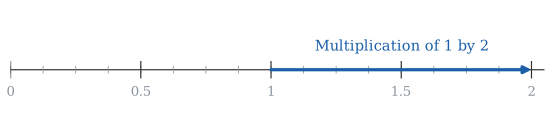
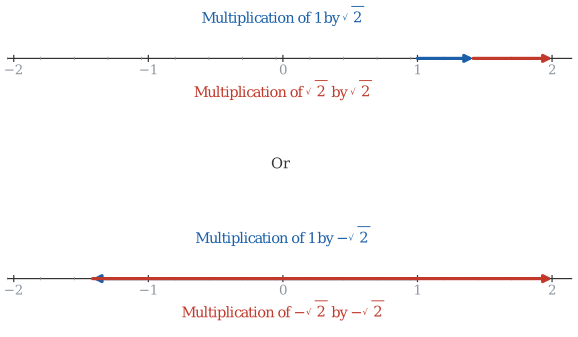
We can also ask about the square root of 2. What that really means is: What is the operation (in terms of moving on the number line) which, when you do it twice takes you from 1 to 2. Well, we can first multiply by $\sqrt{2}$ which takes us to $\sqrt{2}$ and then multiply by $\sqrt{2}$ again to get to 2, or indeed we can multiply by $-\sqrt{2}$ (reflect to -1, then scale to $-\sqrt{2}$) and then multiply again by $-\sqrt{2}$ (reflect by -1 which takes us to $\sqrt{2}$ then scale by $\sqrt{2}$ which takes us to 2).
We could ask something a bit more tricky. We could ask if you can multiply by -1 in two equal steps. We saw above that reflecting twice (ie. multiplying by a negative number twice) keeps us on the same side of the origin. So how can we do something twice which takes us from 1 to -1. Remember that we are talking about multiplication, not addition. It's easy to get from 1 to -1 in two steps by addition.
In fact, with the number line as it is we can't get from 1 to -1 multiplicatively in two equal steps. We are now going to upgrade our number line and turn it into a number plane and then all will become clear.
Let's simply extend the number line into a number plane. The horizontal axis of this plane is just like the real numbers you know and love, and now there is a new vertical axis which so far doesn't mean much to us.
The wonderful thing about a plane is that we can move around in it in much more complex ways than we can on a line. On a line you can move left and right (either by addition or multiplication), and you can reflect about the origin (if you are multiplying by a negative number).
In a plane we can now rotate. Once we allow for rotation, it's very obvious how we can get from 1 to -1 in two steps...though it's not completely clear yet why this corresponds to multiplication...we will see!
Well, let's just start off by drawing a two dimensional space of numbers. We are going to call one of the axes "Re" (the real number line) and the other axis we will call "Im" (the imaginary number line). The reason for this will become clear soon I hope. Let's start off just by seeing what it would look like to rotate from 1 to somewhere on the imaginary number line and then rotate again to get to -1.
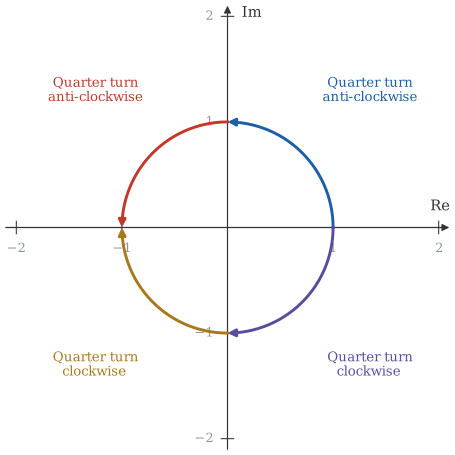
Note that just as with moving from 1 to 2 in two equal steps there are two ways to do this operation..
So...so far in this subsection we haven't mentioned this weird number $i$. However, we've actually just sneaked it in there without you really noticing it.
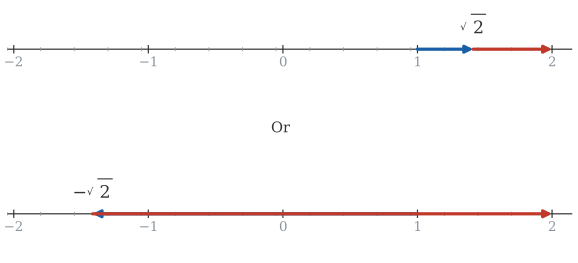
When we asked the question how do you get from 1 to 2 in two equal multiplicative steps we are really asking you to solve:
$$1 \times x\times x=2$$
for $x$. We could also just write this as $x^2=2$. The answer to this of course is $x=\pm\sqrt{2}$.
We could write that number at the point that we get to at the end of the first step and it would look like:
Now we are asking to solve:
$$1 \times x\times x=-1$$
or $x^2=-1$. And we know the answer to that now is $x=\pm i$.
So perhaps the points that we get to at the end of the quarter turns anti-clockwise and clockwise are $i$ and $-i$. In fact this is exactly how we are going to construct what is known as the complex plane.
When we introduced the imaginary number before, it was clear that it wasn't a number like we'd ever seen before, and didn't fit nicely on the real number line, so we are going to give it its own line and extend the number line to a number plane, with one axis being real numbers and the other axis being imaginary numbers.
That then looks like there are more numbers that are imaginary than just $i$. Well, yes, absolutely. To start with we could have, for instance, two lots of i, which we will write:
$$2i$$.
This is a number which, when you square it gives you:
$$(2i)^2=2^2 i^2=4'\times -1=-4$$.
In fact, we can take $i$ and we can multiply it by any real number, $a$ and then you just have $a$ lots of $i$, and this number lies somewhere on the imaginary number line.
You might think as just as you have 1,2,3,4, etc. along the real number line you might have $i$,$j$,$k$,$l$, etc. along the imaginary number line, but remember 2 is just 1+1 and 3 is 1+1+1, so $2i=i+i$ and there isn't another way of writing this number. Along the imaginary direction we only ever have a real number times $i$
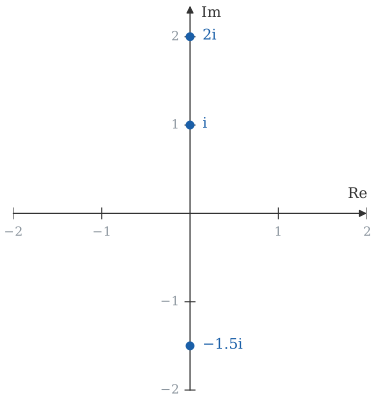
So now we can take any equation of the form $x^2=a$ for any real $a$, be it positive or negative, and find the solutions which are either going to be real numbers if $a$ is positive, or imaginary numbers if $a$ is negative, and we can put them on the number plane, either on the horizontal or vertical axis.
It seems like a sensible time for a definition:
Imaginary numbers
Imaginary numbers are real multiples of the imaginary unit $i$. They take the form $z=ai$ where $a\in\mathbb{R}$.