3. Introducing a new kind of number
What if you knew nothing about negative numbers and I asked you to solve the equation
$$x^2=1$$
You would laugh at how ridiculous I was being and tell me the answer was 1 not realising you'd missed half of the solutions.
In China, around 200BC negative numbers were first introduced. This might be a long time ago, but ideas of counting had been around for a long long time already and so we had mathematics for millenia without having negative numbers.
In Indian mathematics negative numbers were introduced around 620AD with Brahmagupta who introduced them in the concept of debt.
In Greek mathematics where many of the cornerstones of modern mathematics developed, they didn't really concern themselves with negative numbers because they were mostly interested in geometry, and when you're thinking about distances, negative numbers aren't really needed.
In 300AD Diophantus wrote down an equation which would have had a negative solution and said that this was absurd!
Really, negative numbers were understood quite a bit later with the development of mathematics in the Arab world, with the likes of Al-Khwarizmi, Abul-Wafa and Al-Samawal.
If you want to know more, take a look at https://nrich.maths.org/articles/history-negative-numbers.
What if you didn't believe in the existence of irrational numbers and I asked you to find $x$ such that
$$x^2=2$$
You would laugh at how ridiculous I was being and tell me that there is no solution to this. You would be in good company! See The wikipedia article on Irrational Numbers for the history of them.
We have a good way of denoting negative numbers. We just take the magnitude of the number and put a little horizontal line in front of it. It's just some notation, but we know what it means and we know how to manipulate it. For irrational numbers we can't ever write down their digit expansions, but we can write things like $\sqrt{2}$, $e$, $\pi$ and we know what that means.
Well, we are now going to do exactly the same thing but this time with the equation:
$$x^2=-1$$
You first laugh and tell me how ridiculous I'm being as you have done so many times before. However, this time I take my hat off and pull out a new number...
...tada...
The answer, I tell you, is $i$ and $-i$!
What's that? You say.
Well, they are both numbers which, when squared give you -1. That's just how we are going to define them. It need be no more, nor less complicated than that.
The imaginary unit $i$
$i$ and $-i$ are the two numbers which when squared give -1.
$$i^2=-1\, ,\,\,\, (-i)^2=-1$$
This is the starting point of complex numbers and as we will see, it will allow us to do many things that we couldn't do before, including solving equations, like that above, which we thought were unsolvable. It will also bridge areas of mathematics that we thought had nothing to do with each other before, like trigonometry and exponential functions. We'll discover that they are really the same thing, but that only becomes clear when we are allowed to define this weird number $i$, such that $i^2=-1$.
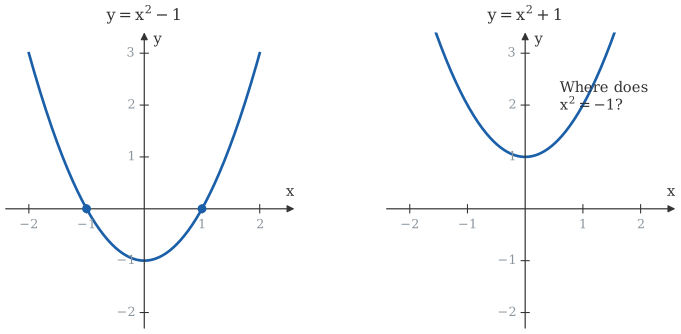
Looking at the equation $x^2=1$ and asking how to solve this using a graph means taking the graph of $y=x^2-1$ and asking when $y=0$. It's obviously where it cuts the $x$-axis. Asking to solve $x^2=-1$ we can look at the graph of $y=x^2+1$ and ask where this cuts the $x$-axis. And suddenly it is clear where the problem lies...it doesn't cut the $x$-axis. But then perhaps the $x$-axis isn't all there is. We will see this in the next section.