14. The Complex Exponential Function
Here we are going to get onto slightly more advanced functions of complex numbers. Up to now we can perform all the basic arithmetic operations on them. and can describe them in a number of ways. We can also take powers of them. We are going to go one step further and ask if we can exponentiate them.
It's pretty clear what taking a power of a complex number means once you understand multiplication: $(1+2i)^5$ is just $(1+2i)$ multiplied by itself five times. What about $e^{1+2i}$? Well, that means taking the number $e$ and multiplying it by itself $(1+2i)$ times.....erm, ok! That doesn't make much sense, does it?
Well, we are going to see that we can define complex exponentiation without needing to understand what it means to multiply something by itself that many times.
The way we are going to define this is to go back to our Maclaurin polynomial definition and just assume that we can extend this to complex numbers. That seems pretty risky, but it will reap some rich rewards. In fact one has to be really careful about when and how you can do this, and we aren't able to go that far here, but if you want to do everything really correctly you do have to worry about such things.
We need to remember three things. Recall the MacLaurin polynomial for $e^x$ where $x \in \mathbb{R}$:
$$e^x\approx 1+x+\dfrac{x^2}{2}+\dfrac{x^3}{3!}+\dfrac{x^4}{4!}+\dfrac{x^5}{5!}+......+\dfrac{x^n}{n!}$$
and for $\cos x$ is
$$\cos x\approx 1-\dfrac{x^2}{2!}+\dfrac{x^4}{4!}-\dfrac{x^6}{6!}+...+ \dfrac{x^{2n}}{(2n)!}$$
and for $\sin x$ is
$$\sin x\approx x-\dfrac{x^3}{3!}+\dfrac{x^5}{5!}-\dfrac{x^7}{7!}+...+ \dfrac{x^{2n-1}}{(2n-1)!}$$
In fact these are equal, and not just approximate in the limit that $n\rightarrow \infty$.
In order to take the Maclaurin polynomial for $e^{iy}$ we are going to do nothing more than replacing $x$ with $iy$ where $y\in\mathbb{R}$:
$$\begin{aligned}e^{iy}&=1+iy+\dfrac{(iy)^2}{2!}+\dfrac{(iy)^3}{3!}+\dfrac{(iy)^4}{4!}+........\\ &=1+iy-\dfrac{y^2}{2!}-\dfrac{iy^3}{3!}+\dfrac{y^4}{4!}+\dfrac{iy^5}{5!}-\dfrac{y^6}{6!}-\dfrac{iy^7}{7!}+....\end{aligned}$$Ok, let's do a bit of rearranging now...
$$e^{iy}=\Big(1-\dfrac{y^2}{2!}+\dfrac{y^4}{4!}-\dfrac{y^6}{6!}+....\Big)+i\Big(y-\dfrac{y^3}{3!}+\dfrac{y^5}{5!}-\dfrac{y^7}{7!}+....\Big)$$
But hang on a moment, we should recognise this from the Maclaurin polynomials of $\cos x$ and $\sin x$ that we wrote above. Remember that $y$ is a real number, so
$$ e^{iy}=\cos{y} + i\sin{y} $$
But this is truly remarkable! Let's step back and see what we have just discovered. Apparently the exponential of an imaginary number (not fully complex yet) is taken by calculating the basic trig functions on the imaginary part of that number. You definitely couldn't plug $e^{3i}$ into a basic calculator (ok, you could on a more complicated one), and so had I asked you what $e^{3i}$ was you wouldn't be able to point to where it is in the complex plane. However, you can definitely calculate $\cos 3$ and $\sin 3$, and these are just the real and imaginary parts of $e^{3i}$ so you can now point out where it is in the complex plane... go on, do it!
What we have just found is that there is an intimate connection between expoential functions and trigonometric functions and that connection is something to do with complex numbers. You never would have expected them to have anything to do with each other. $e$ shows up when thinking about differentiation and integration. Trig functions show up when thinking about circles. This is really beautiful and it was all made possible by Maclaurin polynomials.
Ok, so we can actually go a bit further than this. Here we have only looked at the exponential of an imaginary number. What about a fully complex number (with a real and imaginary part.
Well, in fact for both of these, because we haven't been completely sure that we can use the Maclaurin polynomial of a real number on an imaginary number, we are just going to make these definitions and then see what the consequences are:
Euler's formula and the complex exponential function
For $x, y\in \mathbb{R}$ we define:
(a) $e^{iy}=\cos{y}+i\sin{y}$ (Euler's formula)
(b) $e^z=e^{x+iy}=e^xe^{iy}=e^x(\cos{y}+i\sin{y})$
A special case of Euler's formula (when $y=\pi$) is called Euler's Identity and is considered by many as the most beautiful equations in mathematics:
$$e^{i\pi}+1=0$$
Many people think of Euler's formula as the most beautiful formula in all of mathematics as it involves five numbers from very different spheres of the number realm. Why should $e$ and $\pi$ and $i$ and integer values 0 and 1 have anything to do with each other? In fact when you understand the formula it is really obvious, but without understand complex numbers it makes no sense at all.
This relationship between exponential and trig functions allows us to write the modulus argument form in an even simpler way than before:
For a non-zero complex number, the modulus-argument form i.e. $z=|z|(\cos{\theta}+i\sin{\theta})$ can now be conveniently written as:
$$z=|z|e^{i\theta}$$
We need to get a bit of a feel for what the exponential of a complex number will be. Here is a useful exercise:
- Take a sheet of paper and draw a line down the middle horizontally.
- In the top half draw a copy of the complex plane, with both real and imaginary values ranging from -2 to 2.
- Randomly draw some points in the plane in positions that you can estimate the actual value of the complex number (ie. one of them might be at 1.5-0.5i. Draw some along the axes, and some not on the axes. Maybe draw 10 points.
- For each of these calculate the exponential using the formula above.
- Now draw another copy of the complex plane in the bottom half of the page.
- Plot the positions of the exponentials of the complex numbers that you had in the top half - ie. the answers you found when you calculated the exponential of the first points.
- See if you can see any pattern that is emerging. Do you see any periodicity? Do you see what makes the exponential smaller or larger, or in different positions in the complex plane?
In the following we do this not for a series of discrete points, but for a series of lines. See if you can figure out which red lines on the left are mapped to which red lines on the right and blue lines to blue lines under the complex exponential function.
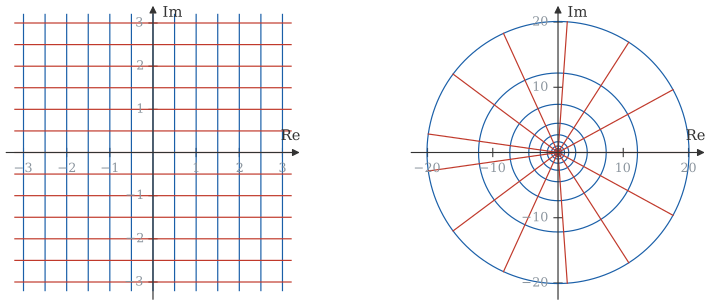
One really important point to note here is that infinite lines get mapped to circles. This you might have guessed by the way the exponential function is really trigonometric in disguise, and is thus periodic. This means that it's not invertible. It's many to one (just as for $\cos$ and $\sin$).
As we have done before, once we write down a definition we can explore its properties. We will list these but each of them can be proved.
Properties of the complex exponential function:
If $z_1,z_2$ and $z=x+iy$ are complex numbers, and $n,k \in \mathbb{Z}$ then,
- $e^{z_1}e^{z_2}=e^{z_1+z_2}$
- $e^{z_1-z_2}=\dfrac{e^{z_1}}{e^{z_2}}$
- $(e^z)^n=e^{zn}$
- $arg(e^z)= \{ y+2\pi n \quad | \quad n\in \mathbb{Z}\} $
- $|e^z|=e^x$
- If $e^z=1$ then $z=2\pi ki$
- If $e^{z_1}=e^{z_2}$ then $z_1-z_2=2k\pi i$
- $e^{z+2\pi i n}=e^z$
Remark: Property 14.1(h) tells us that $f(z)=e^z$ is a periodic function with period $2\pi i$. This implies that $f(z)=e^z$ has no inverse function, unless we restrict the domain of $f(z)$, in this course, we will not define the complex logarithm function, you'll see the function in MAM3000W if you take complex analysis.
We will prove properties 14.1(a) and 14.1(e) leave the rest for homework exercises.
Proof of property 14.1(a): Let $z_1=x_1+iy_1$ and $z_2=x_2+iy_2$ where $x_1,x_2,y_1,y_2 \in \mathbb{R}$.
$$\begin{aligned}e^{z_1}e^{z_2}&=e^{x_1+iy_1}e^{x_2+iy_2}\\ &=e^{x_1}e^{iy_1}e^{x_2}e^{iy_2} && \textbf{Definition \href{../sec14-the-complex-exponential/#defn-14-1}{14.1}(b)}\\ &=e^{x_1}(\cos{y_1}+i\sin{y_1})e^{x_2}(\cos{y_2}+i\sin{y_2}) && \textbf{Definition \href{../sec14-the-complex-exponential/#defn-14-1}{14.1}(a)}\\ &=e^{x_1}e^{x_2}(\cos(y_1+y_2)+i\sin(y_1+y_2)) && \textbf{Theorem \href{../sec11-de-moivre-theorem/#thm-11-1}{11.1}}\\ &=e^{x_1}e^{x_2}e^{i(y_1+y_2)} && \textbf{Definition \href{../sec14-the-complex-exponential/#defn-14-1}{14.1}(a)}\\ &=e^{x_1+x_2}e^{i(y_1+y_2)} && \textbf{Exponential laws for $\mathbb{R}$}\\ &=e^{(x_1+x_2)+i(y_1+y_2)} && \textbf{Definition \href{../sec14-the-complex-exponential/#defn-14-1}{14.1}(b)}\\ &=e^{(x_1+iy_1)+(x_2+iy_2) }\\ &=e^{z_1+z_2}\quad \Box\end{aligned}$$Proof of property 14.1(e): Let $z=x+iy$ where $x,y \in \mathbb{R}$.
$$\begin{aligned}|e^z|&=|e^{x+iy}|\\ &=|e^xe^{iy}| && \textbf{Definition \href{../sec14-the-complex-exponential/#defn-14-1}{14.1}(b)}\\ &=|e^x||e^{iy}| && \textbf{Property \href{../sec8-conjugate-and-modulus/#prop-8-2}{8.2}(f)}\\ &=e^x|\cos{y}+i\sin{y}| && \textbf{Since $e^x$ is a positive real number}\\ &=e^x\sqrt{(\cos^2{y}+\sin^2{y})} && \textbf{Definition \href{../sec7-identities-inverses-and-division/#defn-7-2}{7.2}(b)}\\ &=e^x \quad \quad\Box\end{aligned}$$Solve for $z \in \mathbb{C}$ and plot all the solutions on an Argand diagram:
- $e^z=\sqrt{3}+i$
- $e^{iz}=1+\sqrt{3}i$
- $e^z=|1+\sqrt{3}i|$
Sketch the image of set $S$ under the mapping $f$ if:
$f(z)=e^z$ and $S=\{ z \in \mathbb{C}|\ 1\leq Re(z)< 2 \quad ,\ -\frac{1}{\sqrt{3}}<Im(z)\leq \sqrt{3}\}$
Show solutions
Let $z=x+iy$, where $x,y\in\mathbb{R}$, ie. $e^z=e^{x+iy}=e^xe^{iy}$. Then write the right hand side in exponential form: $$e^xe^{iy}=\sqrt{3}+i=2 e^{i(\dfrac{\pi}{6}+2\pi k)}$$ where $k\in\mathbb{Z}$. Now we equate the moduli and argument of both sides to get:
$$e^x=2\implies x=\ln 2$$
and
$$y=\frac{\pi}{6}+2\pi k$$
which means that
$$z=x+iy=\ln 2+i\left(\frac{\pi}{6}+2\pi k\right)\, ,\,\,\, k\in\mathbb{Z}$$
(All solutions will be plotted on the same diagram after the last example.
The same process here. Let $z=x+iy$:
$$\begin{aligned}& e^{iz}=e^{i(x+iy)}=e^{-y}e^{ix}=1+\sqrt{3}i \\ & \implies e^{-y}e^{ix}=2e^{i(\frac{\pi}{3}+2\pi k)}\, ,\,\, k\in\mathbb{Z}\\ & \implies e^{-y}=2, \,\,\, x=\frac{\pi}{3}+2\pi k\\ & \implies z=\frac{\pi}{3}+2\pi k-i\ln 2\, ,\,\, k\in\mathbb{Z}\end{aligned}$$And again. Let $z=x+iy$:
$$\begin{aligned}e^{x+iy}& = e^xe^{iy}=|1+\sqrt{3}i|=2e^{i 2\pi k}\, , \,\,\, k\in\mathbb{Z}\\ & \implies x=\ln 2\, ,\,\,\, y=2\pi k\\ & \implies z=\ln 2+2\pi i k\, ,\,\, k\in\mathbb{Z}\end{aligned}$$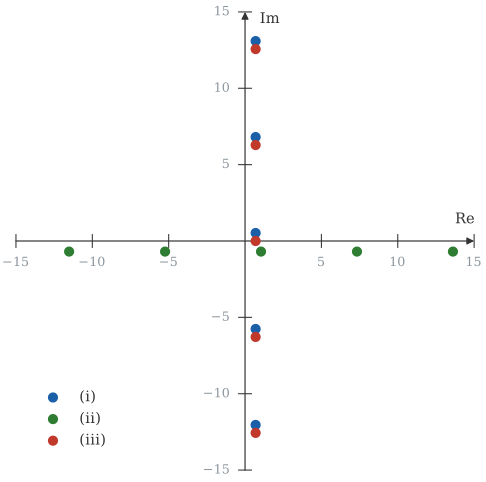
(i): Blue, (ii): Green, (iii): Red. These are a subset of the infinite families of solutions.
We are here given a set $S$ which is some region in the complex plane, and we are asked what happens to this set of numbers when we apply the exponential function to them. Let's start by drawing the original set:
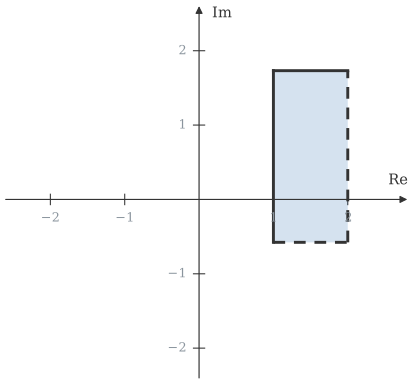
The question is what do the points in this region get mapped to under the exponential function? We can start with something slightly simpler than the whole region. Let's just take the left, vertical side of the region. This set could be denoted as
$$\{z\in \mathbb{C}| Re(z)=1,-\frac{1}{\sqrt{3}}<Im(z)\le \sqrt{3}\}$$
ie. these are numbers of the form $z=1+i b$ where $-\frac{1}{\sqrt{3}}<b\le \sqrt{3}\}$. What happens to these when we exponentiate them? Well, they become:
$$e^{1+ib}=e^1e^{ib}$$
These are numbers with modulus $e$ and argument $b$ where $-\frac{1}{\sqrt{3}}<b\le \sqrt{3}\}$. This corresponds to an arc of radius $e$ sweeping out the range of angles given by $b$. It looks like:
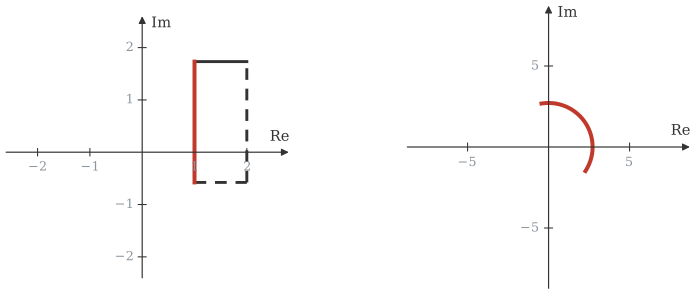
The left-most vertical line gets mapped to an arc of radius $e$. We could do exactly the same thing with the outer vertical line and this would give the same thing, except it would have radius $e^2$:
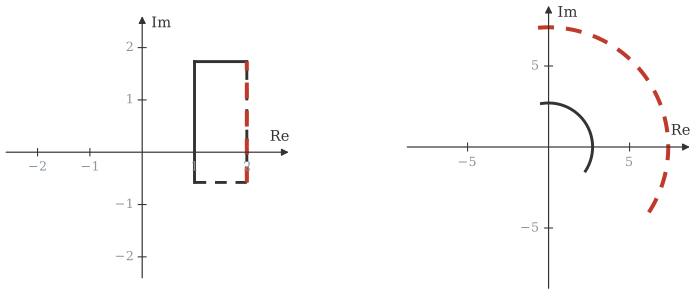
The right-most vertical line (which is not actually included in the region) gets mapped to an arc of radius $e^2$. How about the top sloping line in the original region? This is the set of points:
$$\{z\in \mathbb{C}| 1\le Re(z)<2,Im(z)=\sqrt{3}\}$$ That is: $$z=a+i\sqrt{3}$$ where $1\le a<2$. When we exponentiate this we get: $$e^z=e^ae^{i\sqrt{3}}=e^a(\cos\sqrt{3}+i\sin\sqrt{3})=e^a(\cos\sqrt{3}+i\sin\sqrt{3})$$
This is a set of numbers with modulus $e^a$ where $1\le a<2$ and with constant argument given by $\sqrt{3}$. This gives the new line in the following:
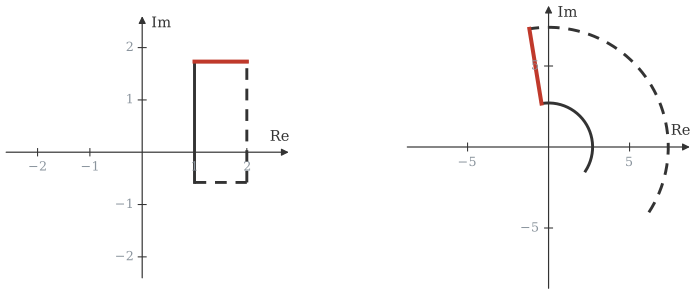
The top line gets mapped to the new line here And finally for the lower horizontal line we do the same thing as above and come to:
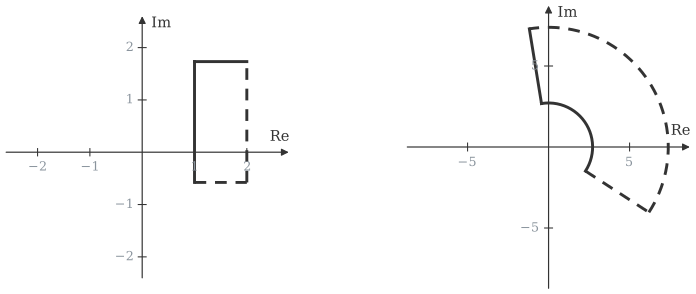
All four sides of the region are now mapped. Convince yourselves at this stage that in fact any point in the middle of the original set will be mapped to a point inside this new region. Thus we have:
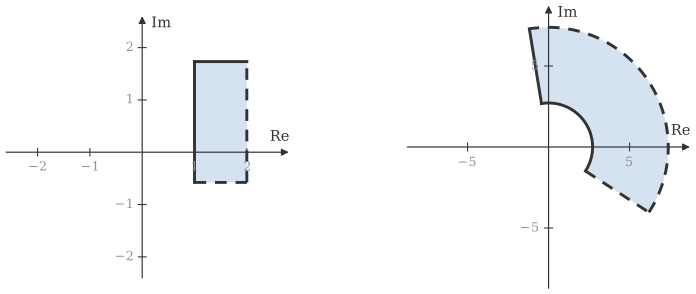
and the interior of the region is also mapped.
Solve for $z \in \mathbb{C}$ and write the solution is a cartesian form. Sketch all the solutions on an Argand diagram if:
- $e^z=1+i$
- $e^{iz}=1+i$
- $e^{-z}=-\sqrt{3}+i$
- $e^z=|1+i|$
- $e^{\overline{z+i}}=4i$
- $|e^z|=|1+i|$
- $e^{|z|}=|1+i|$
Useful facts:
If $z_1$ and $z_2$ are complex numbers, then:
1. $z_1z_2=(r_1e^{i\theta_1})(r_2e^{i\theta_2})=r_1r_2e^{i(\theta_1+\theta_2)}$
2. $\dfrac{z_2}{z_1}=\dfrac{r_2e^{i\theta_2}}{r_1e^{i\theta_1}}=\dfrac{r_2}{r_1}e^{\theta_2-\theta_1}$ provided $z_1 \neq 0$
Prove the following properties of the complex argument:
(i) $Arg(z_1z_2)=Arg(z_1)+Arg(z_2)$ (ii) $Arg(z_1\overline{z_2})=Arg(z_1)-Arg(z_2)$
Show that:
(i) $e^{z+\pi i} =-e^z$ (ii) $\overline{e^z}=e^{\overline{z}}$
- If $\alpha$ is an argument of $w$ and $\beta$ is an argument of $z$ (where both $w$ and $z$ are complex numbers, find the argument of $\dfrac{w^2z}{\overline{w}}$ if possible.
- If $Arg((a + i)^3) =\pi$ , where $a$ is real and positive, find the exact value of $a$.
Write the following complex numbers in a cartesian form i.e. form $a+bi$
- $(\sqrt{3}-i)^6$
- $(\dfrac{\sqrt{3}}{2}-\dfrac{i}{2})^{24}$
- $(-1+i)^{16}.e^{-\dfrac{i\pi}{2}}$
- $(\sqrt{3}-i)^5(-\frac1{2}+\frac{\sqrt{3}}{2}i)^{15}$
- If $z=\sqrt{3}+i$ and $w=1+\sqrt{3}i$ find modulus-argument forms for $zw, \dfrac{z}{w}$, and $\dfrac1{z}$.
Sketch the image of set $S$ under the mapping $f$ if:
$f(z)=e^{iz}$ and $S= \{ z \in \mathbb{C}\ |\ \dfrac{\pi}{6}\leq Re(z) < \dfrac{\pi}{3},\ 0 <Im(z)\leq 1\ \}$
Show that the function $w=e^z$ maps the rectangle in Figure 14(a) to the semi-annulus in Figure 14(b)

The function $e^z$ mapping a rectangle to a semi-annulus the plane - Prove properties 14.1.