13. Functions of a complex variable
We have already hinted at one function of a complex number, but we haven't really thought about it very deeply. So far in general we have only looked at real-valued functions of a real variable. $f:\mathbb{R}\rightarrow \mathbb{R}$.
We often use a graphical way of describing such a function using the curve $y=f(x)$ in the $(x,y)$ plane, which says that for each ordered pair $(x,y)$ such that $y=f(x)$ there is a point. In fact this doesn't need to give a curve, as it could just be a discrete set of points, but generally it will be a curve.
Can we do the same thing for a function of the form $f:\mathbb{C}\rightarrow\mathbb{C}$? We would need to find points $(z,w)$ such that $w=f(z)$ but both $z$ and $w$ are complex numbers which can only be denoted by two real numbers. ie. $z=a+bi$ and $w=c+di$. So really we need four real numbers $(a,b,c,d)$, such that $c+di=f(a+bi)$. So we need four axes? Well, that's not going to work with our simple two dimensional paper!
Instead of this, we write down two versions of the complex plane, one for $z$ and one for $w$. We then draw on some set of points on the $z$ plane and ask where those points go to under the map. The points we chose may be discrete points, or they may be a curve.
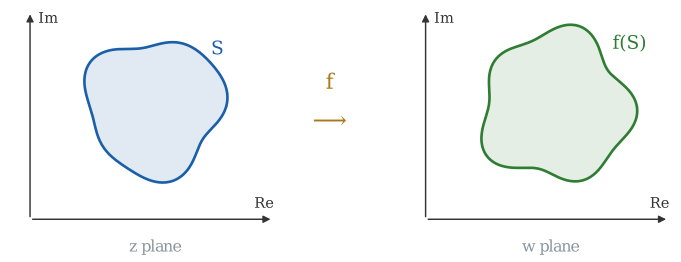
We already saw one example of this in the section where we were asking about the multiplicative inverse of a complex number where $f(z)=1/z$. We will see another example in a little bit.