11. Multiplication and de Moivre's Theorem
Remember when we first saw the basic arithmetic operations on complex numbers? Addition in Cartesian form was really easy, but multiplication, which had this lovely geometric interpretation (it's just rotations) was not so simple. Remember in Cartesian form: $(a+bi)(c+di)=(ac-bd)+(ad+bc)i$ which is just a bit messy. It turns out that in modulus argument form, multiplication is super simple!
Multiplication of two complex numbers in the modulus-argument form
Suppose that $z= |z|(\cos{\alpha}+i\sin{\alpha})$ and $w=|w|(\cos{\beta}+i\sin{\beta})$ are non-zero complex numbers in the modulus-argument form, then their product is:
$$zw=|z||w|\Big(\cos{(\alpha+\beta)}+i\sin{(\alpha+\beta)}\Big)$$
Remark: This theorem gives us the geometric interpretation for multiplication of complex numbers, i.e. multiplying two complex numbers is equivalent to multiplying their moduli and adding their arguments.
The proof of the theorem is as follows:
Proof of Theorem 11.1
$$\begin{aligned}zw&=\Big(|z|(\cos{\alpha}+i\sin{\alpha})\Big)\Big(|w|(\cos{\beta}+i\sin{\beta})\Big) && \textbf{Modulus-argument form }\\ &=|z||w|\Big(\cos{\alpha}+i\sin{\alpha}\Big)\Big(\cos{\beta}+i\sin{\beta}\Big) && \textbf{Commutative property }\\ &=|z||w|\Big( \cos{\alpha}\cos{\beta}+i\cos{\alpha}\sin{\beta}+i\cos{\beta}\sin{\alpha}-\sin{\alpha}\sin{\beta}\Big) && \textbf{Definition \href{../sec6-arithmetic-operations/#defn-6-2}{6.2}}\\ &=|z||w|\Big( (\cos{\alpha}\cos{\beta}-\sin{\alpha}\sin{\beta})+i(\cos{\alpha}\sin{\beta}+\cos{\beta}\sin{\alpha})\Big) && \textbf{Definition \href{../sec6-arithmetic-operations/#defn-6-1}{6.1}}\\ &=|z||w|\Big(\cos{(\alpha+\beta)}+i\sin{(\alpha+\beta)}\Big) \quad \textbf{Compound angle identities}\quad\Box\end{aligned}$$and visually, we can see an example of the product of two complex numbers here:

This is something really fundamental to understand and remember:
In modulus argument form, when you multiply together two complex numbers, the moduli multiply and the arguments add.
How would you write down the complex number $i$ in modulus argument form?
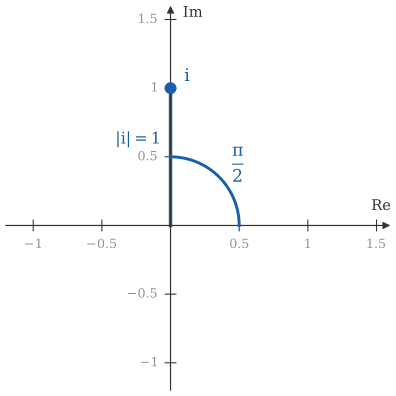
Well, it sits on the imaginary axis, and therefore has principal argument $\frac{\pi}{2}$. Thus:
$$i=1\left(\cos(\frac{\pi}{2})+i\sin(\frac{\pi}{2})\right)$$
This means that multiplying a complex number $z=|z|(\cos\alpha+i\sin\alpha)$ by $i$ can be written as:
$$zi=|z|(\cos(\alpha+\frac{\pi}{2})+i\sin(\alpha+\frac{\pi}{2}))$$
ie multiplication by $i$ is equivalent to rotation by $\frac{\pi}{2}$ in the complex plane...which is one of the ways that we first came across $i$.