10. The Modulus-Argument form of a complex number
We've seen now that you can use $|z|$ and $arg(z)$ to pinpoint a number in the complex plane. Now we are going to discover how to write $z$ explicitly using these quantities
Consider the diagram below:

It's clear using our basic trigonometry that we can relate many of these quantities. In particular:
$$\sin{\theta}=\dfrac{b}{|z|} \Rightarrow b=|z|\sin{\theta}$$
and
$$\cos{\theta}=\dfrac{a}{|z|} \Rightarrow a=|z|\cos{\theta}$$
But this means that we can write:
$$z=|z|\cos{\theta}+i|z|\sin{\theta} = |z|(\cos{\theta}+i\sin{\theta})$$
There's a specific name for this form:
Modulus-Argument form of a complex number
If $z$ is a non-zero complex number and $\theta$ is an argument of $z$, then the expression $$z=|z|(\cos{\theta}+i\sin{\theta})$$ is called the modulus-argument form of $z$.
It is usual to choose $\theta$ to be the principal argument of the $z$.
The modulus-argument form is also known as the polar form.
Write the following complex numbers in the modulus-argument form.
- $z=1+i$
- $z=1-i$
- $z=-\sqrt{3}-i$
- $z=-1+\sqrt{3}i$
Show solutions
In each of these cases we just have to use that $|z|=\sqrt{Re(z)^2+Im(z)^2}$ and trigonometry to calculate the principal argument. Here we plot each of the numbers in the complex plane:
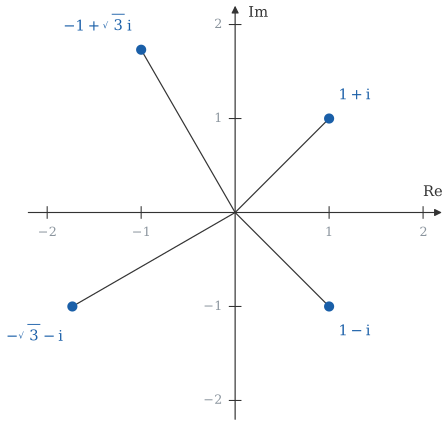
Looking at the first one, the argument is just the angle subtended between the positive real axis and the line joining the origin to the number. We see that this is a triangle with base 1 and height 1, and thus the angle is $\arctan(1)=\frac{\pi}{4}$. Then length of the hypotenuse is $\sqrt{1^2+1^2}=\sqrt{2}$. Thus we can write:
$$1+i=\sqrt{2}(\cos(\frac{\pi}{4})+i\sin(\frac{\pi}{4}))$$
For the next number the angle is the same, but just measured in the opposite direction (ie. clockwise) and is therefore negative the previous one. So:
$$1-i=\sqrt{2}(\cos(-\frac{\pi}{4})+i\sin(-\frac{\pi}{4}))$$
For the next number we have to be a bit more careful with the calculation of the angle. Both parts are negative, and so we can measure the angle between the negative real axis and the line between the origin and the number, and then add $\pi$ on to that.
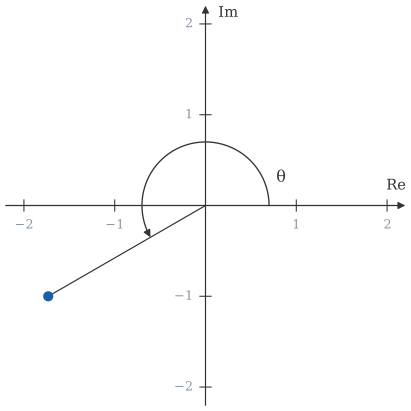
So this argument is: $\pi+\arctan\left(\frac{1}{\sqrt{3}}\right)=\pi+\frac{\pi}{6}=\frac{7\pi}{6}$, and therefore (having calculated that $\sqrt{(-\sqrt{3})^2+(-1)^2}=2$:
$$-\sqrt{3}-i=2(\cos\frac{7\pi}{6}+i\sin\frac{7\pi}{6})$$
Note that when we defined the principal argument we actually said that it had to be between $-\pi$ and $\pi$ but sometimes we will choose to represent the argument in the range $[0,2\pi)$.
For the last example, you should get:
$$-1+\sqrt{3}i=2(\cos\frac{2\pi}{3}+i\sin\frac{2\pi}{3})$$
Write the following complex numbers in the modulus-argument form.
- $-\sqrt{3}+i$
- $5-5\sqrt{3}i$
- $-3-3i$
- $\sqrt{3}+i$
- $-1+i$