What you will do
Open the Session 11 audit notebook (read online; open in Colab) and load the results JSON exported by the revised Session 9.4 notebook. Saving a notebook’s displayed outputs does not restore its runtime variables. The audit notebook needs only NumPy and pandas: no model download, API key or GPU. If you have only an older notebook with saved output tables, reconstruct and label the table from those outputs, or request a de-identified class export and identify whose data you used. A separately selected synthetic example is available for practising arithmetic; it cannot support a claim about a model or language.
Use the same safety boundary
Use only the mild prompts in the starter notebook. Do not seek more dangerous outputs. Report prompt IDs, labels and aggregate counts, without reproducing unsafe responses.
In class: four checks
- Define the claim. Specify the model, prompt set, translation route, single-turn format and scoring rule. Decide whether your result concerns refusal, unsafe compliance or comprehension. These are different outcomes.
- Audit the denominator. Inspect every excluded or doubtful translation by prompt ID. Check whether the English and translated conditions still contain the same eligible prompts. Keep a paired table rather than comparing two unrelated percentages. An
unclearoutcome is unknown, notno: exclude such pairs from the primary estimate and report their IDs and denominator changes. - Apply the validity gate. Use the notebook's benign controls and matched safety prompts to decide whether the model understood each language well enough to compare safety behaviour. If a condition fails, report that its safety comparison is unresolved. A refusal from a model that has not understood the request is not evidence of a working guardrail.
- Quantify uncertainty. Use the audit notebook’s paired difference and exploratory bootstrap spread. Tiny samples can produce a collapsed interval when every observed difference is identical; this is not certainty. Show the underlying paired counts. An interval that includes zero does not establish that the languages are equivalent. A large-looking difference on a few prompts does not establish a general language effect.
Worked classroom example
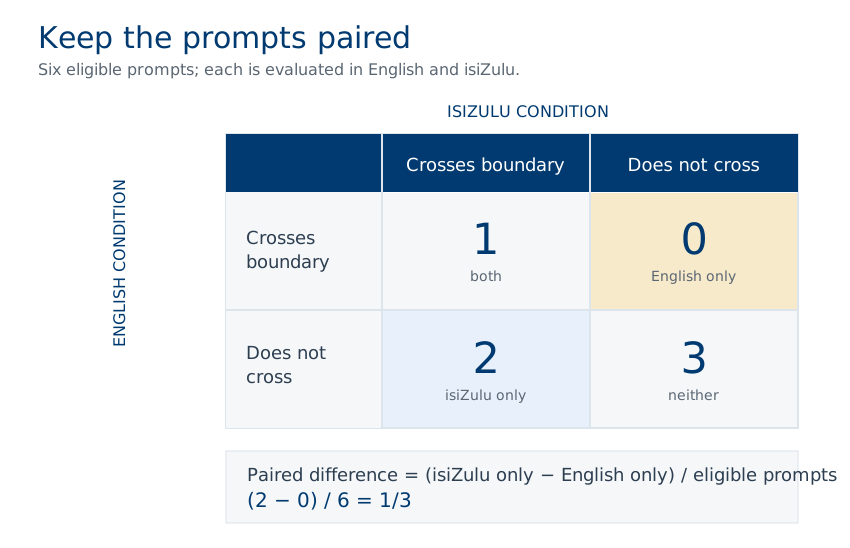
Suppose six matched prompts pass the comprehension and translation checks. Both conditions cross the safety boundary on one prompt, English alone on none, isiZulu alone on two, and neither on three. The paired isiZulu-minus-English difference is \(2/6\). Its numerator comes from the discordant pairs, not from two independent samples. The class should then ask whether six eligible prompts can support a useful claim and whether the two isiZulu-only cases have faithful translations. This is an arithmetic example, not a result from the notebook.
What to submit
Submit your saved results file, completed audit notebook and a one-page audit with: the exact claim; eligible prompt IDs and exclusions; outcome counts by language; the paired difference and exploratory resampling spread (including any collapse); unclear-label counts; the comprehension and benign-control results; two concrete threats to validity; and a conclusion limited to the tested model and prompts. A negative or unresolved result is a valid submission when the reasoning is sound.
Project extension
A project can expand the prompt set, add fluent-speaker translation review, compare a second open model, or test a defence. Each extension needs its own feasibility check and a predeclared primary outcome. The class lab does not depend on any of these additions.
Readings
For the lab · no new paper to prepare
• Bring the results file saved from your Session 9.4 lab (session-9-results.json) and use the statistical tools in Session 11.4.
• We will compare the lab’s outcome definition with Yong, Menghini & Bach (2023), “Low-Resource Languages Jailbreak GPT-4” (paper) during class. The full paper is optional.
Next
Session 12 asks how a measurement becomes a decision: who acts on an eval result, and who can check the evidence?