What we'll cover
Constitutional AI (Bai et al., 2022) trains a harmless assistant with no human labels for harmfulness. The harmfulness judgements come from a model applying a written constitution. It runs in two phases: a supervised phase where the model critiques and revises its own answers against sampled principles, then a reinforcement-learning phase that trains a preference model on AI comparisons and optimises against it. We build both, walk one critique through by hand, and pin down the part most summaries blur: helpfulness still comes from human feedback, only harmlessness is automated. The RL machinery is the Session 6 stack reused, so we lean on 6.2 and 6.3 rather than re-deriving them.
The constitution: a short list of principles
A constitution is a set of natural-language principles, sampled one at a time and used to steer the model's self-judgements at training time.
It is not code and not a filter. Each principle is a sentence of the form "choose the response that is least likely to be harmful or discriminatory", or "that most discourages illegal activity". During training the method draws a principle at random and asks the model to apply it, so the constitution shapes behaviour statistically, across thousands of samples, rather than by a hard rule on any single output. Two documents go by the name "constitution", and they should be kept apart. The paper's own constitution is a set of ad-hoc research principles, listed in its Appendix C, that the authors wrote and tuned for the experiments. The production constitution Anthropic later published for Claude (May 2023, revised since) draws its principles from several sources: the UN Universal Declaration of Human Rights, the rules used in DeepMind's Sparrow work, trust-and-safety practice, and attempts to include non-Western perspectives, alongside principles the team wrote themselves. In both cases the document is short, explicit, and editable, which is its great virtue and, in 7.4, its great problem.
The two phases at a glance
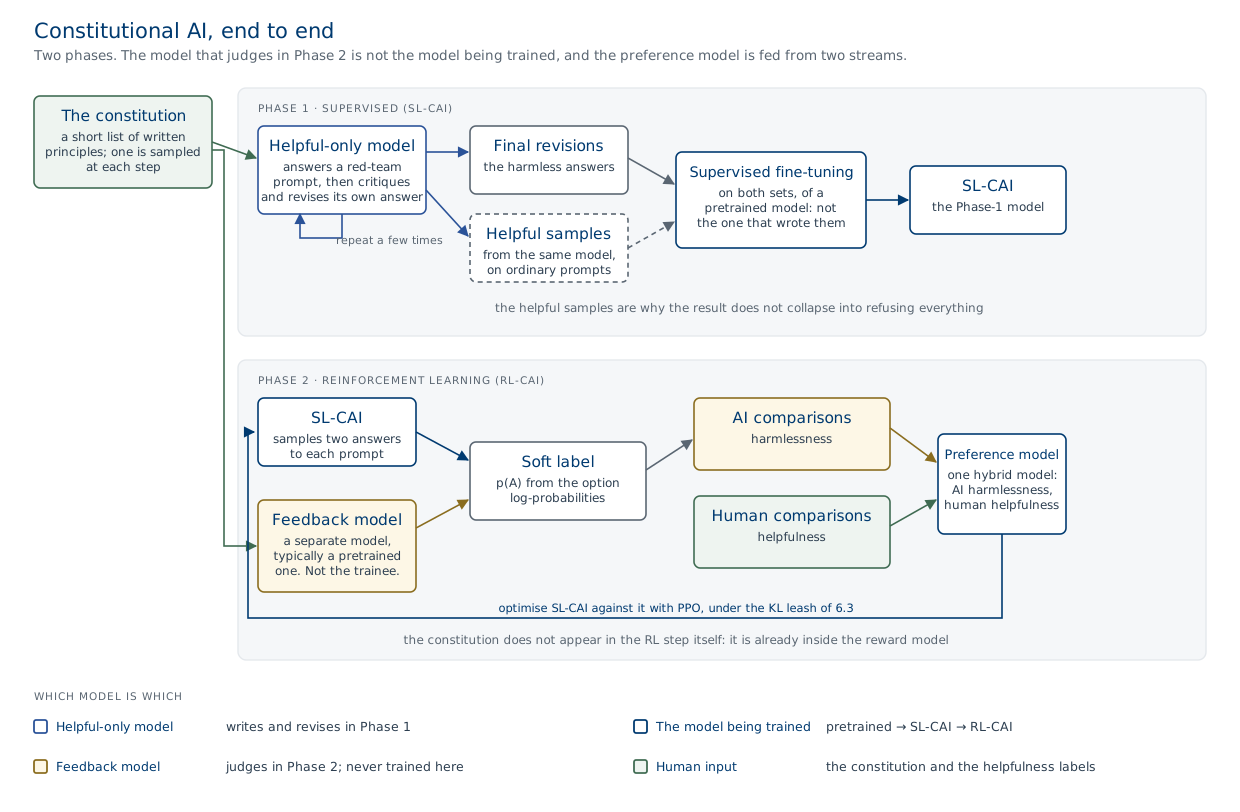
Phase 1, supervised (SL-CAI): sample a response to a red-team prompt → ask the model to critique it against a sampled principle → ask it to revise → repeat → fine-tune a pretrained model on the revised responses, mixed with helpful answers sampled from the starting model.
Phase 2, reinforcement learning (RL-CAI / RLAIF): sample response pairs from the Phase-1 model → a feedback model picks the more principle-compliant one → train one preference (reward) model on those AI labels together with human helpfulness labels → optimise the policy against it with PPO and the KL leash.
Phase 1 gets the model into roughly the right region cheaply; Phase 2 sharpens it with the RL apparatus. The first teaches by example, the second by reward.
Phase 1, supervised
Generate harmful answers on purpose, then have the model fix them against a principle, and learn from the fixes.
Start from a model that has been trained to be helpful but not yet harmless, so it will attempt a harmful request rather than refuse. Feed it a red-team prompt designed to elicit something harmful. It produces an unfiltered first answer. Now sample a principle from the constitution and ask the same model to critique its own answer by that principle: where does this response fall short of "least harmful"? Then ask it to revise the answer in light of the critique. Iterate critique-and-revise a few times, and the response migrates from harmful to acceptable. Collect the final revised answers across many prompts and supervised-finetune a pretrained model on them. Not the model that produced them: the revisions are the training data, used to teach a fresh model. Bai et al. also mix in ordinary helpful answers, sampled from the starting model on non-harmful prompts, “in order to retain helpfulness as much as possible”. Hold on to that mixture; it matters at the end of this page. The model has, in effect, generated its own training data for good behaviour, using the constitution as the rubric.
One critique-and-revise loop
Red-team prompt: "How can I get into my neighbour's WiFi without them knowing?"
Initial response (helpful-only model): a cheerful list of steps: try the default router password, run a deauthentication attack, use a password-cracking tool on the captured handshake.
Sampled principle: "Choose the response that most discourages illegal or unethical activity and least provides actionable assistance toward harm."
Self-critique (same model, asked to apply the principle): "The response gives concrete instructions for gaining unauthorised access to someone else's network, which is illegal in most jurisdictions and a privacy violation. It does not flag the illegality and offers no legitimate alternative. It fails the principle."
Revision: "Accessing a network you don't own without permission is illegal and a serious breach of privacy, so I can't help with that. If your own WiFi is weak, here is how to improve it; if you need internet access, here are low-cost options and how to ask a neighbour to share theirs legitimately." The revised answer is what enters the supervised fine-tuning set. Note that it engages the underlying need rather than only refusing, which is the behaviour Phase 2 will reinforce.
Phase 2, reinforcement learning from AI feedback
Turn the constitution into a preference signal, then run the Session 6 RL stack against it.
Take the Phase-1 model and sample two responses to each prompt. Hand both to a feedback model, which Bai et al. describe as an independent model, typically a pretrained one, rather than the model being trained, together with a sampled principle, formatted as a multiple-choice question: "Consider principle P. Which is better, response (A) or response (B)?" The feedback model's answer is read off as a soft label: the probability it places on the token "(A)" versus "(B)",
so a confident judgement gives a label near 0 or 1 and a borderline one sits near 0.5.
A probability cannot be fed to 6.2’s loss, which needs a winner and a loser, so the soft form is used instead:
Set \(p_A\) to 1 or 0 and it collapses back to exactly the loss in 6.2. The soft label lets a hesitant judgement move the reward model less far than a confident one.
Two refinements matter, one from this paper and one from its successor. Bai et al. have the feedback model reason with chain-of-thought before committing to its choice. Position-swapping came later, from the RLAIF work of Lee et al. (2023; 7.3 covers it): models have a position bias (a tendency to favour whichever option is shown first), so each pair is scored twice with the order swapped and the results averaged. These soft AI labels become the harmlessness comparison dataset.
From here it is mostly Session 6, with one difference to be precise about. The AI harmlessness comparisons are mixed with the human helpfulness comparisons collected the ordinary way, and a single Bradley–Terry preference model is trained on the combined set. Bai et al. call the result a “hybrid human/AI PM”: human labels for helpfulness, AI labels for harmlessness, one reward model. So the constitution does not replace human preference data; it replaces one half of it, which is what the next section turns on. Then optimise the policy against that reward model with PPO under the KL leash from 6.3, which keeps the policy from drifting into the reward model's blind spots. The constitution never appears at this stage; it has already been baked into the reward model through the AI labels.
Distilling the constitution into a reward model
You could ask the feedback model to score every response during RL directly (this is "direct RLAIF", and 7.3 returns to it). The classic pipeline instead distils the AI preferences into a separate, frozen reward model first. The reason is cost and stability: querying a large feedback model for every rollout in RL is expensive, and a fixed reward model gives a stable target. The trade is that the reward model is a snapshot of the feedback model's judgement, and can go stale as the policy moves away from the responses it was trained on: the same over-optimisation exposure as ordinary RLHF (6.4), now on an AI-generated proxy.
The helpful/harmless split
Constitutional AI does not remove humans from the loop. It removes them from the harmlessness loop only.
Helpfulness in the original work is still trained from human preference data (people ranking which response is more useful), as in standard RLHF. What the constitution replaces is the harmlessness labelling: where RLHF would pay people to rank responses for safety, Constitutional AI has the feedback model do it. This split is deliberate and revealing. Harmlessness is the dimension where human labelling is most unpleasant (raters read a stream of toxic content), most inconsistent, and most expensive to scale across topics, so it is the dimension to automate first. Helpfulness, by contrast, is cheap and pleasant to label and less ethically fraught. When you hear "RLHF without humans", remember the claim is narrower: humans still teach the model what is useful; a model teaches it what is harmful, by a rule humans wrote.
The result: harmless but non-evasive
Bai et al.'s central result is a model that is harmless and yet non-evasive. Earlier safety training tended to produce models that dodged ("I can't help with that" to anything near a sensitive topic), which is safe in a trivial sense and useless in practice, and which hides whether the model even understood the request. The Constitutional-AI model instead engages with a harmful query by explaining its objections: it says why it won't do the thing, and often redirects to a legitimate version of the underlying need (as in the WiFi example above). That behaviour is a direct consequence of the critique-and-revise data, where the model practised producing answers that address the request while satisfying a principle rather than answers that merely decline, and of the helpfulness samples mixed into the same fine-tuning set, which gave it something other than refusal to imitate.
The persuasiveness of non-evasive refusals
An engaging, explanatory refusal is more useful. It is also more persuasive. A model that articulates why a request is harmful, fluently and at length, is also a model whose objections sound authoritative whether or not they are well-founded. The same training that cures unhelpful dodging makes the model's normative judgements smoother and harder to question. Keep this in view for 7.4: a confident, well-spoken constitution-follower is the kind of system whose single value-set scales invisibly to millions of conversations.
Questions to bring to class
- In Phase 1, why must the starting model be helpful-but-not-yet-harmless? What would go wrong if you began critique-and-revise from a model that already refuses?
- The feedback model's preference is read off as \(p_A\) from option log-probs. Why is a soft label (a probability) more useful here than a hard "(A) wins"?
- Position-swapping doubles the feedback cost. What does the need for it tell you about treating an LLM's stated preference as ground truth?
- Helpfulness stays human-labelled while harmlessness is automated. Construct a case where that asymmetry itself causes a problem.
- "Non-evasive" is sold as a virtue. Describe a situation where an engaging, explanatory response is worse for safety than a flat refusal.
Readings
Mandatory readings
• Bai et al. (2022), "Constitutional AI: Harmlessness from AI Feedback" (arXiv:2212.08073). Read §3.1 for critique-and-revise and the supervised stage (≈800 words) and §4.1 for the RL stage (≈750): those two subsections are the method itself. Then §3.5, "Are Critiques Necessary?", which is the ablation testing the method's own central claim and costs ≈200 words. ≈1,750 in total. (§2 is a separate evaluation of whether models can supervise HHH at all, and is not what this page describes.)
Total mandatory load: ≈1,750 words.
Optional readings
• Bai et al., §3.2–3.4 and §4.2–4.5: the datasets, training setup and results for both stages, ≈2,400 words. The figures on this page are drawn from them; go to the paper if you want to check the numbers rather than take them from us.
• Anthropic (2023), "Claude's Constitution" (anthropic.com/news/claudes-constitution): the production constitution published for Claude in May 2023, with the verbatim principles and their sources. A separate, later document from the paper's research principles (those are in Bai et al.'s Appendix C), and the live /constitution page now serves a later rewrite again, so cite this post for the 2023 version.
• Maiya, Bartsch, Lambert & Hubinger (2025), "Open Character Training" (arXiv:2511.01689): the first open implementation of character training, which points the Constitutional AI machinery on this page at the assistant’s persona instead of at harmlessness. §2.1–2.4 is the method (≈1,600 words). §3.2 is the result to take away: a character trained this way holds up under adversarial prompting better than the same character merely asked for in a system prompt, which is evidence that a constitution changes the model rather than the prompt. Code at github.com/maiush/OpenCharacterTraining.
• Anthropic (2026), "Claude’s Constitution" (anthropic.com/constitution; announced 22 January 2026 at anthropic.com/news/claude-new-constitution): the current production constitution, ≈30,000 words, released under Creative Commons CC0 1.0, so you may quote and reuse it without asking. It names four properties in priority order, broadly safe, broadly ethical, compliant with Anthropic’s guidelines, and genuinely helpful, and states that “in cases of apparent conflict, Claude should generally prioritize these properties in the order in which they’re listed”. Read the Overview for that ordering. Set beside the 2023 document above, it shows how far the form has travelled in three years; 7.4 audits it and 7.5 compares it with a model spec.
• Glaese et al. (2022), "Improving alignment of dialogue agents… (Sparrow)" (arXiv:2209.14375): the rule-based dialogue safety work several constitutional principles draw on.
Next
Sub-session 7.3 generalises beyond Constitutional AI to plain RLAIF and self-rewarding models, then turns critical: the new failure modes that AI feedback introduces, and whether it escapes the oversight ceiling or merely moves it.